7 Horses Pyrite Frame and Painting: Vastu Direction and Placement
Advice on seven-horses art disagrees mostly about the wall, with east and south the usual answers. The rule nearly every vastu school shares is about movement instead: the horses should run into the room, never towards the main door or out of a window.
People ask about the 7 horses painting vastu direction more than almost any other piece of decor, and the answers online rarely agree. That is because there is no single classical rule for it: the seven-horses image is a popular custom that grew out of older ideas about the Sun, movement and the directions. Below, the walls most often suggested are set against the room zones Astroliya's own vastu tool uses.
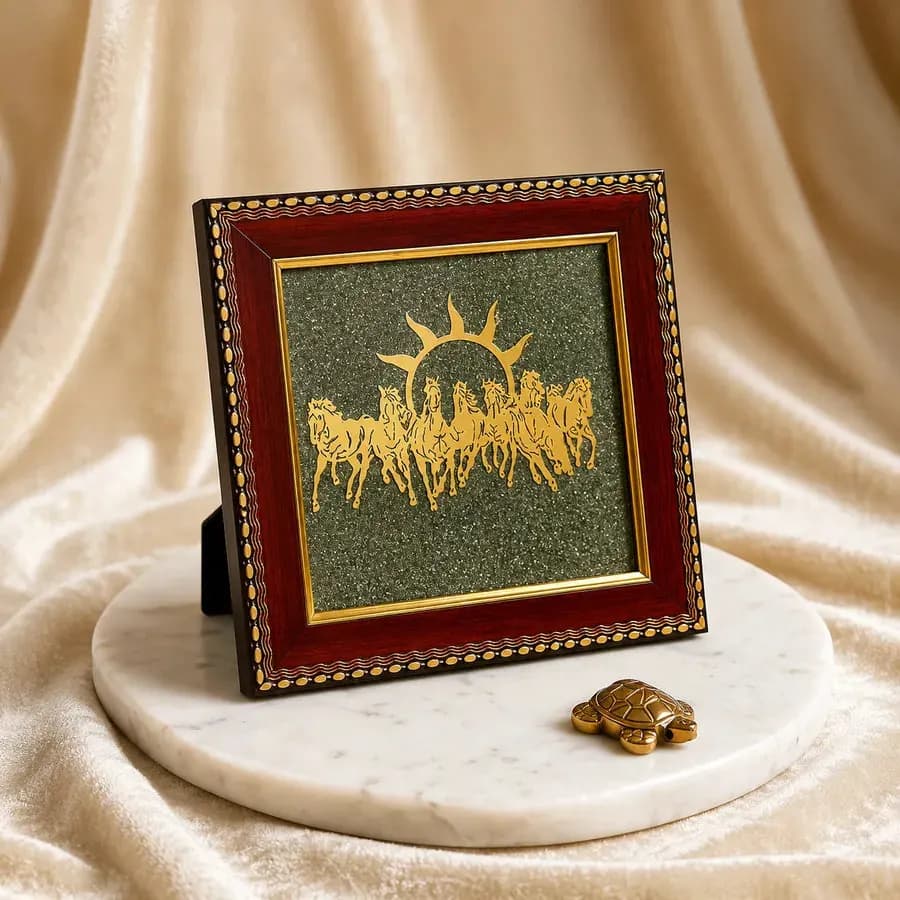
Many people now skip the painting for a hand-sized frame of seven horses set on raw pyrite, and size changes the placement: a frame is meant to be seen at arm's length, on a desk, shelf or study wall, not to anchor a whole living-room wall.
Why seven horses, and where the idea comes from
In Hindu tradition the Sun god, Surya, rides a chariot drawn by seven horses, an image found in the Puranas and in temple art such as the Konark Sun Temple. Running horses also carry an everyday meaning across cultures: speed, stamina and moving forward together. Popular vastu joined the two, and the seven galloping horses became a symbol people hang where they want a sense of momentum, often in a workplace or a study.
What the classical vastu texts describe is the layout of a building: which rooms suit which directions. They do not give rules for a seven-horses picture. So everything below about this particular piece is common custom, and where schools disagree we say so.
7 horses painting vastu direction: the short answer
The three walls most often suggested, and the reason each school gives:
| Wall | Why people choose it | Who usually suggests it | Keep in mind |
|---|---|---|---|
| East | The direction of sunrise, linked with Surya, whose chariot the seven horses pull | Those who read the piece as a Sun symbol | Works well in a study, which Astroliya's tool places in the north or east |
| South | Many modern vastu consultants link the south with fame and recognition | The most common suggestion for an office or living room | Keep it bright; avoid a dim or damp south wall |
| North | Traditionally Kubera's direction, read as opportunities and career | An alternative when the south wall is not usable | Pair with a tidy, well-lit corner |
Which way the horses should run
This is the point almost every school agrees on, and it matters more than the compass. The horses should look as if they are running into the room or the house, not out of it.
- In a living room, they should not appear to gallop towards the main door or out of a window.
- In an office, they usually face into the room or towards your desk, so that the movement is "towards" the work.
- On a wall beside the main door, they should run inwards, away from the doorway. Our main door vastu guide explains why the horses usually go further inside the home rather than at the entrance itself.
Many people also prefer the horses to run together as one group, with the full bodies visible rather than cut off at the edge of the picture, and with steady, purposeful faces rather than a wild or frightened look. White horses are the most common choice, linked with calm and purity in popular readings. All of these are matters of taste within the custom, not requirements.
Room by room, on Astroliya's vastu zones
Astroliya's free vastu tool gives one zone for each room, and those zones are a useful frame for deciding where the horses fit, and where they do not.
| Room | Astroliya's zone for the room | Seven horses here? | Notes |
|---|---|---|---|
| Entrance | North, north-east or east | Possible, beside the door, running inwards | Most people keep it a little further inside |
| Study | North or east | A good fit | An east wall in view of the desk is a common choice |
| Office or work desk | Not covered by the tool | A very common place | Often the south wall, behind or facing the desk |
| Living room | Not covered by the tool | Common | South, east or north wall, horses running into the room |
| Puja room | North-east | Usually not | The puja space is kept for images of worship |
| Bedroom | South-west for the main bedroom | Usually not | Running horses are an active image; rest comes first |
| Kitchen | South-east | No | Grease and heat dull pyrite and canvas alike |
The study
A study in the north or east, as the tool suggests, already sits on the walls that the Sun-symbol school prefers. Hang the horses where you see them when you look up from the desk, not directly behind your head where you never notice them. Our study room vastu guide covers desk direction and light.
The office or work desk
Astroliya's vastu data does not cover offices, so this is purely custom. Many people put the horses on the south wall of a cabin, either behind the chair or facing it. At a shared desk, a small frame on the desk itself is more practical than a wall piece.
The puja room and the bedroom
The pooja room is traditionally kept for deities and objects of worship, so a decorative horse image is usually placed elsewhere. In the bedroom, the advice in our bedroom vastu guide is to keep the room calm, and a galloping image is the opposite of that intention.
Painting or raw pyrite frame: which suits your wall
Size decides more than symbolism here. A painting is usually large enough to anchor a living-room or office wall. A pyrite frame is small and is meant to be seen at arm's length.
| 7 horses painting | 7 horses raw pyrite frame | |
|---|---|---|
| Typical size | Often wall-sized, from medium to very large | Astroliya's frame is 7.5 x 7.5 inches |
| Best place | A main living-room or office wall | A desk, a shelf or a small study wall |
| Material | Print or paint on canvas or board | Horses set on raw pyrite, a brassy mineral |
| Upkeep | Dust; keep out of harsh sun and damp | Keep dry; pyrite can tarnish in humid air |
| Reads from | Across the room | Close up |
The listing for the 7 Horses Raw Pyrite Vastu Frame states the frame size as 7.5 x 7.5 inches and calls it "especially suitable for an office, business space, study room or living area". It describes the seven running horses as "traditionally associated with speed, strength, success and forward movement" and raw pyrite as "traditionally regarded as a symbol of wealth, abundance and financial growth". It does not state the frame material, the weight or whether it hangs on a hook or stands on a table, so check the photos on the product page if that matters for where you plan to put it.
The store's other pyrite frame, the 7 Trunk Elephant Pyrite Wall Frame, is listed at 19 x 19 cm, which is about the same size, and as a wooden frame with raw pyrite stones; neither is a wall-sized piece, so for a large wall a painting is the better fit. Our pyrite frames for home guide compares the frames and the Lakshmi Yantra pyramid side by side, and all of them are in the spiritual and vastu decor collection.
Pyrite frame placement in five steps
- Pick the room first. Decide whether the piece is for a study, an office desk or the living room. Skip the puja room, bedroom and kitchen.
- Find the walls. Stand in the middle of the room with a phone compass and note which walls face east, south and north. The vastu tool shows the room zones on a board if you want to check your layout.
- Choose the wall you will actually see. Of the walls the custom allows, pick the one in your line of sight from where you sit most.
- Set the direction of the horses. Turn the frame so the horses run into the room, away from the door and away from any window.
- Check the conditions. Avoid a damp wall, a spot above a sink or a wall shared with a bathroom, and hang it at about eye level, where it will be dusted.
A worked example (an illustration, not a rule)
Say a two-bedroom flat has its study corner on the east side of the living room, and the only free south wall is the television wall. The 7.5-inch pyrite frame is too small to hold its own beside a television, so the owner puts it on a shelf on the east wall above the study desk, angled so the horses run towards the middle of the room. A larger painting, if they want one later, would suit the south wall of the main living area better than the television wall, where it would compete for attention.
Putting it up on Dhanteras, Diwali or Akshaya Tritiya
Many families bring new decor or vastu items home on days already linked with prosperity. None is required; any day you have time to hang it carefully is fine. Dates for New Delhi, per Drik Panchang (check your city):
| Occasion | 2026 | 2027 |
|---|---|---|
| Dhanteras | 6 November | 27 October |
| Diwali (Lakshmi Puja) | 8 November | 29 October |
| Akshaya Tritiya | — | 9 May |
Our guides to Dhanteras, Diwali and Akshaya Tritiya explain each day and the timings people follow.
What a seven-horses frame can and cannot do
In the tradition, a symbol like this is a reminder: something you see daily that points your attention at effort and steady progress. That is the honest frame for it.
- It does not raise income, win a promotion or fix a business on its own. Those still depend on work, planning and, for money decisions, qualified financial advice.
- It does not cancel a difficult period in a horoscope, and there is no need to buy one to follow vastu.
- It does not fix a building's real problems. Damp, poor light and structural issues are for an architect or engineer, and our vastu tips for money explain what simple home changes can and cannot do.
If you are weighing a career move and want to see what your own chart shows, Astroliya's AI astrologer can read your kundli in Hindi or English and explain its reasoning; it treats remedies and decor as optional, never as a promise.
Questions people ask
Which direction should a 7 horses painting face?
The horses should look as if they are running into the room or the house, never out of the main door or a window. The wall itself is usually south, east or north, depending on the school. Of these, the direction of movement is the part almost every school agrees on.
Is a 7 horses pyrite frame the same as a 7 horses painting?
They carry the same symbolism, but they are different objects. A painting is usually large and suits a main wall, while Astroliya's pyrite frame is 7.5 x 7.5 inches and suits a desk, shelf or small study wall. Pyrite also needs to be kept dry, as it can tarnish in humid air.
Can I keep a seven horses painting in the bedroom?
Most vastu advice says no, because a galloping image is active and the bedroom is meant for rest. The puja room and kitchen are also usually avoided. A study, office or living room is the usual home for it.
Can it go in an office?
Yes, an office is one of the most common places for it. Many people put it on the south wall of a cabin, behind or facing the chair, with the horses running into the room. At a shared desk, a small frame on the desk is the practical option.
How do I clean a pyrite frame?
Dust it with a soft, dry cloth or brush. Avoid water, sprays and salt-water "cleansing", which can speed up tarnishing on pyrite, and keep the frame away from bathrooms, sinks and damp walls.
From the Astroliya store
Pieces for this guide
Chosen from our own store to go with what you just read.
 45% off7 Horses Raw Pyrite Vastu Frame for Wealth, Success & Career Growth₹549
was ₹999Buy 10% offLakshmi Yantra Pyramid with Free Raw Pyrite Stone for Wealth & Prosperity₹899
was ₹999Buy 53% offASTROLIYA 7 Trunk Elephant Pyrite Wall Frame for Wealth & Prosperity₹699
was ₹1,499Buy 50% offLibra Zodiac Energy BraceletNatural Lapis Lazuli & Howlite Crystal Bracelet₹499
was ₹999Buy