

Lakshmi Yantra Pyramid With Pyrite: Meaning, Placement and Care
Where does a Lakshmi Yantra pyramid go? Vastu traditionally keeps it in the north-east puja corner or on the north side of a room, and the raw pyrite that often comes with it needs a dry shelf far more than a salt-water cleanse.
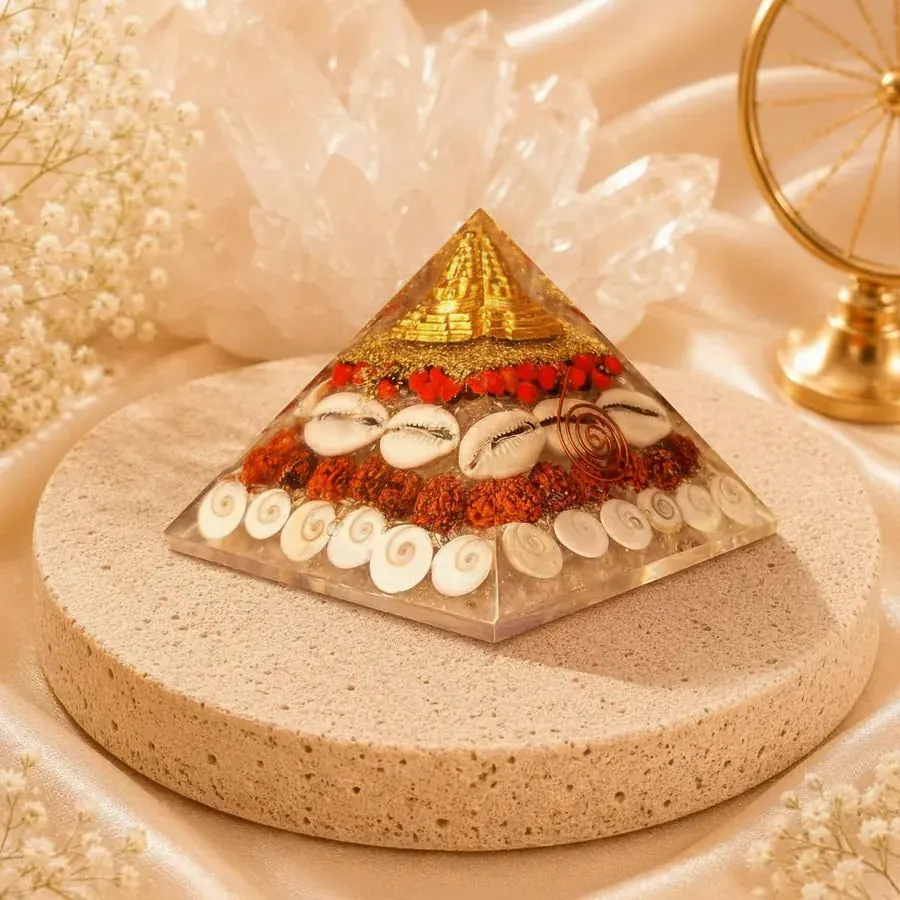
A Lakshmi Yantra pyramid is a small desk or altar piece: the yantra, a geometric diagram used in the worship of Goddess Lakshmi, shown on a pyramid shape, and in many sets paired with a piece of raw pyrite. People keep it in the puja corner, on a work desk or near a cash box as a reminder of Lakshmi, the goddess of prosperity and well-being. Of its three parts only the yantra comes from worship itself; the pyramid shape and the pyrite are modern decor customs, and knowing which is which makes the placement advice easier to follow.
One thing first, because it shapes everything below: a yantra is a focus for prayer and intention in the tradition. It is not a money machine, and nothing on this page promises that it will change your income.
What the Lakshmi Yantra is in the tradition
In Hindu worship a yantra is a diagram that stands for a deity, used much as an idol or a picture is: something to sit before, to offer a lamp or flowers to, and to hold the mind steady during a mantra. Classical tantric and puja manuals describe many yantras, each built from a few recurring shapes.
A Lakshmi Yantra is usually drawn with:
- an outer square with four openings, the "bhupura", read as the boundary of a sacred space with gates in the four directions
- rings of lotus petals, since the lotus is Lakshmi's seat and symbol
- inner triangles or a six-pointed star around a central point
- often the seed syllable Shreem, which is associated with Lakshmi
Designs vary between lineages and makers, so two genuine Lakshmi Yantras can look different. That is normal and not a sign that one is "wrong".
Lakshmi, Shree and Kuber yantras compared
These three are often sold side by side and confused with each other.
| Yantra | Usually drawn as | Associated with | Common use |
|---|---|---|---|
| Lakshmi Yantra | Square with gates, lotus petals, inner triangles, often "Shreem" | Goddess Lakshmi | Puja corner, desk, Diwali worship |
| Shree Yantra (Sri Chakra) | Nine interlocking triangles around a central point, within lotus rings and a gated square | The Goddess as Lalita Tripurasundari; widely linked with abundance | Meditation and puja; treated with more formal ritual in some traditions |
| Kuber Yantra | Commonly a grid of numbers | Kubera, keeper of the gods' treasury | Cash box, locker, shop counter |
If you are choosing between them, the honest answer is that it comes down to which form of worship you and your family already follow. Someone who does Lakshmi Puja every Diwali will usually feel most at home with a Lakshmi Yantra.
Why a Lakshmi Yantra pyramid comes with pyrite
The pyramid shape is a modern addition. Pyramid objects became popular in home-decor vastu only in recent decades; the classical vastu texts deal with plots, buildings and rooms, not decor pyramids. Treat the shape as a way of displaying the yantra rather than as an ancient rule.
Pyrite is iron disulphide, a brassy, metallic mineral that people nicknamed "fool's gold" for its colour. In crystal and vastu decor it is linked with abundance and confidence, mostly because it looks like gold. That association is a modern custom too, which is why you will find pyrite frames, pyrite clusters and pyrite pyramids sold for money corners. Our guide to pyrite frames for the home covers the larger wall pieces.
Put together, the set is symbolic twice over: Lakshmi's diagram for the intention, and a gold-coloured stone as a visible reminder of it.
What is in Astroliya's set
The Lakshmi Yantra Pyramid with Free Raw Pyrite Stone listing on our store describes two things:
- a Lakshmi Yantra pyramid, which the listing calls "a traditional symbol of Goddess Lakshmi, wealth and prosperity" for "Vastu décor, puja spaces, offices and business areas"
- a free raw pyrite stone, which it describes as "traditionally associated with abundance, prosperity, confidence and financial growth"
The listing names home, office, shop, business space, puja room and gifting as uses. It does not state the pyramid's size, its material, how the yantra is applied to it or the weight of the stone, so check the product page for photos and ask before buying if one of those matters to you. Raw pyrite is a natural lump, so no two stones will look exactly alike. You can see it beside the other pieces in the Spiritual and Vastu Decor collection.
Lakshmi Yantra placement: where vastu traditionally keeps it
Astroliya's free vastu tool places the puja room in the north-east, the Ishan corner, and suggests facing east or north while you pray. Because a yantra is an object of worship, the puja corner is the most traditional home for it. The north is also traditionally linked with Kubera and wealth in vastu, which is why many families keep a Lakshmi or Kuber piece in a north-facing spot in the living room or near the cash box.
| Where | Why people choose it | Keep in mind |
|---|---|---|
| Puja corner in the north-east | The classic place for any object of worship | Keep it clean, simple and well lit |
| North side of the living room | North is traditionally Kubera's direction | A shelf at or above eye level, not on the floor |
| Work or study desk | A daily reminder of a goal | Place it on the north or east side of the desk if you can |
| Cash box, locker or shop counter | An old custom of keeping Lakshmi near money | Tradition, not a security measure |
The same vastu notes list a few things to avoid for the puja space, and they apply to a yantra too:
- a spot under a staircase
- a wall shared with a bathroom
- keeping it beside broken idols or torn pictures
Many families also prefer the yantra not to sit directly on the floor or in the bedroom. If you have a full puja room, our pooja room vastu guide goes into idol height, the direction you face and what to keep out.
A worked example (an illustration, not a rule)
Say a two-bedroom flat has a bathroom in its north-east corner, which is common in city apartments. Vastu advice would not put the yantra on the bathroom wall. Instead:
- Find the nearest clean wall or shelf in the north or east of the living room.
- Check that it does not share a wall with the bathroom.
- Place the pyramid on a small cloth or wooden stand at or above eye level, so that you face east or north when you stand before it.
- Keep the pyrite stone beside it rather than tucked away in a drawer, so it stays visible and dry.
Vastu offers ideal directions; real homes rarely match them perfectly. The tradition itself expects you to work with the space you have, and a clean, cared-for spot matters more than an exact compass reading.
When to set it up: Dhanteras, Diwali or any good day
Many families bring home a new Lakshmi piece on Dhanteras or install it during Diwali Lakshmi Puja, because both days centre on Lakshmi. Others choose Akshaya Tritiya, which is traditionally treated as an auspicious day for new purchases. Dates for New Delhi, from Drik Panchang (check your city):
| Occasion | 2026 | 2027 |
|---|---|---|
| Dhanteras | 6 November | 27 October |
| Diwali (Lakshmi Puja) | 8 November | 29 October |
| Akshaya Tritiya | Already passed | 9 May |
Dhanteras puja is done in Pradosh Kaal, the window just after sunset, so its timing depends on your own city's sunset. You can read more in our guides to Dhanteras and Diwali, or check a day's panchang with the muhurat tool. None of these dates is required. Any morning when you can sit quietly for a few minutes is fine for a household setup.
A simple way people set it up
Customs differ from family to family; this is one common pattern, and none of it is compulsory.
- Clean the spot and wipe the pyramid with a dry cloth.
- Place the yantra facing you as you sit facing east or north.
- Light a diya or incense and offer a flower or a little rice.
- Repeat a Lakshmi mantra you know, such as "Om Shreem Mahalakshmyai Namah", for a round of a mala if you use one.
- After that, a lamp on Fridays or on festival days is how many people keep it "alive" in their routine.
If you would rather not perform a ritual, simply placing it with a clear intention is a perfectly reasonable choice.
Care and handling: keep the pyrite dry
The yantra pyramid needs only a soft, dry cloth to dust it. If it has a printed or coated surface, avoid sprays and harsh cleaners that can lift the design.
Pyrite needs a little more thought because of what it is made of:
- Keep it dry. Iron disulphide can tarnish, and in damp air it may slowly break down and leave a rusty or powdery film. A dry shelf away from a bathroom or kitchen sink helps.
- Skip water and salt. Online "cleansing" advice often suggests soaking crystals in water or salt water. For pyrite that can speed up tarnishing. If you want a cleansing ritual, people use incense smoke, a few minutes of mantra or a short time in morning light instead.
- Handle with clean, dry hands and dust it now and then with a soft brush.
- Keep it away from small children and pets, as raw stone has sharp edges and is not something to mouth or swallow.
A stone that develops a dull patch is not "absorbing bad energy"; it is ordinary weathering. Wipe it dry and move it somewhere less humid.
What a Lakshmi Yantra does and doesn't do
Astrologers and vastu practitioners traditionally describe a yantra as a support for prayer: it gives the mind a fixed point and turns an intention into a daily habit. That is the honest frame for it.
What it does not do:
- It does not raise income, clear debts or win a deal on its own. Money decisions still need a budget, a plan and, where needed, a qualified financial adviser.
- It does not cancel a difficult period in your chart. If you want to understand a dasha or transit, look at your own free kundli rather than an object.
- It is not a fix for a home's real problems. Damp, poor light or clutter are worth solving for their own sake, and our vastu tips for money piece is clear about what such changes can and can't do.
- It does not need to be expensive, "energised" for a fee or bought on a particular day to be valid in the tradition.
If prosperity is on your mind because of a specific question, such as a job change or a business decision, a reading of your own birth chart can help you think it through. You can ask Astroliya's AI astrologer about your own chart. It is an AI, not a person, and its answer is a reading of the tradition, not a forecast or financial advice.
Questions people ask
What is the difference between a Lakshmi Yantra and a Shree Yantra?
A Shree Yantra is built from nine interlocking triangles around a central point and is associated with the Goddess as Lalita Tripurasundari. A Lakshmi Yantra is centred on Lakshmi herself, usually with lotus petals and her seed syllable Shreem. Both are linked with abundance; most households choose the one that fits the worship they already do.
Which direction should a Lakshmi Yantra face?
Vastu traditionally keeps it in the north-east puja corner, or on the north side of a room, placed so that you face east or north while praying before it. Keep it off the floor and away from walls shared with a bathroom. If your north-east corner is not usable, the nearest clean north or east spot is the usual fallback.
Does the pyrite stone need cleansing?
Physically, it only needs dusting and to be kept dry. Water and salt-water soaks, often suggested for crystals, can make pyrite tarnish, so avoid them. If you like a ritual cleanse, incense smoke or a few minutes of mantra are gentler choices.
Is a Lakshmi Yantra pyramid a good housewarming or Diwali gift?
Many people give one for a griha pravesh, a new shop or Diwali, because Lakshmi is welcomed into new beginnings. It suits someone who already keeps a puja corner or likes vastu decor. For someone who does not follow these customs, a note saying it is a symbol of good wishes keeps the gift in the right spirit.
Can I keep it at my office or shop?
Yes. The listing itself names office, shop and business spaces, and keeping Lakshmi near the cash counter is an old custom. A clean shelf on the north or east side, at or above eye level, is the traditional choice.
From the Astroliya store
Pieces for this guide
Chosen from our own store to go with what you just read.
 10% offLakshmi Yantra Pyramid with Free Raw Pyrite Stone for Wealth & Prosperity₹899
was ₹999Buy 50% offLibra Zodiac Energy BraceletNatural Lapis Lazuli & Howlite Crystal Bracelet₹499
was ₹999Buy 50% offLeo Zodiac Energy BraceletNatural Tiger Eye & Clear Quartz Crystal Bracelet₹499
was ₹999Buy 50% offTaurus Zodiac Energy BraceletNatural Lepidolite & Carnelian Crystal Bracelet₹499
was ₹999Buy