
Pyrite Frames for Home: 7 Horses, 7-Trunk Elephant or Lakshmi Yantra, and Where Each Goes
Pyrite is iron sulphide, the mineral nicknamed fool's gold, and the classical vastu texts never mention pyrite frames: the wealth link is modern folk custom drawn from its colour. So picking a pyrite frame for home comes down to the motif and the room.
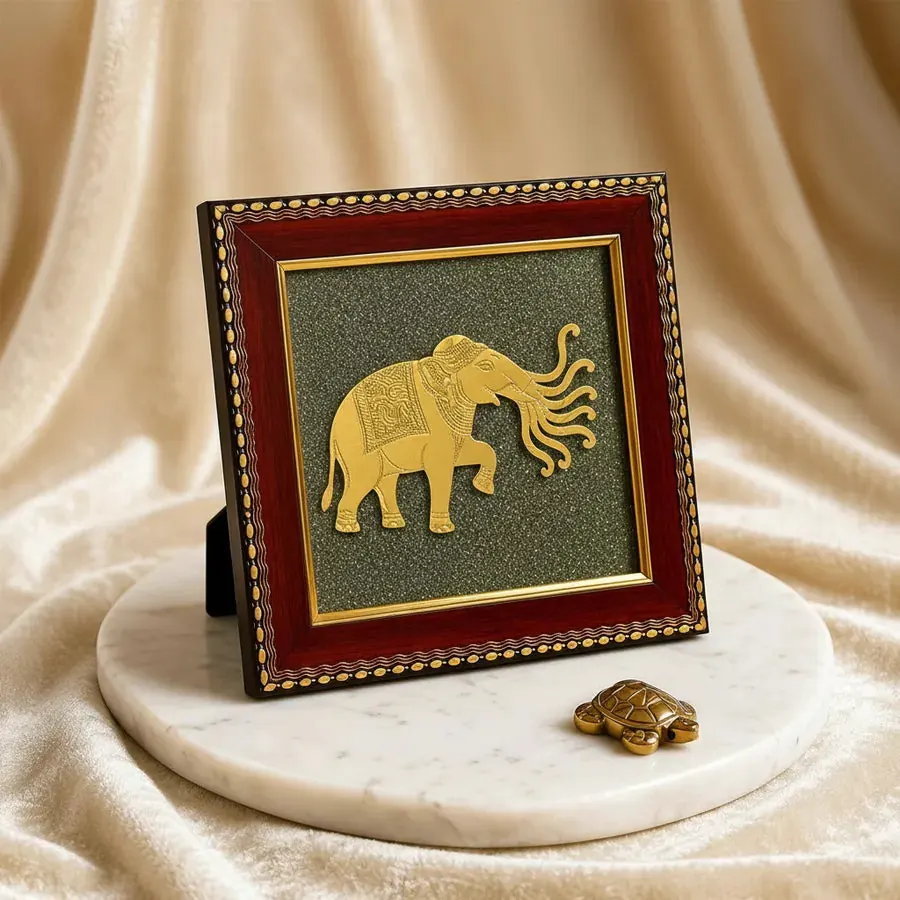
If you are choosing a pyrite frame for home, the first question is not "which is luckiest" but "which room is it for". A study desk, a front entrance and a puja corner each call for something different, and the three pyrite pieces in Astroliya's Spiritual and Vastu Decor collection happen to cover those three spaces. The 7 horses frame's listing points to a study or office, the elephant frame's to a living room or entrance, and the Lakshmi Yantra pyramid's to a puja room among other spaces; the room zones below follow our free vastu tool.
A short note before the details: these are decor pieces that carry traditional symbols. They can be a pleasant reminder of an intention. They do not change a bank balance, and you do not need any of them to follow vastu.
The pyrite frame for home: three pieces side by side
Astroliya's store has three pyrite pieces, so a fair comparison fits in one table. Everything in the size and material columns is quoted from the product listings as they read on 27 October 2026; where a listing is silent, we say so rather than guess.
| 7 Horses frame | 7-Trunk Elephant frame | Lakshmi Yantra pyramid | |
|---|---|---|---|
| Listing | 7 Horses Raw Pyrite Vastu Frame | 7 Trunk Elephant Pyrite Wall Frame | Lakshmi Yantra Pyramid with Free Raw Pyrite Stone |
| Motif | Seven running horses | An elephant with seven trunks | A Lakshmi yantra on a pyramid |
| Stated size | 7.5 x 7.5 inches (frame) | 19 x 19 cm | Not stated |
| Stated material | Raw pyrite with the horse design; frame material not stated | Wooden frame with raw pyrite stones | Not stated for the pyramid; comes with a separate raw pyrite stone |
| Form | A square frame | A wall frame, as its name says | A pyramid, not a frame, plus a loose stone |
| Spaces the listing suggests | Office, business space, study room or living area | Living room, office, entrance area, pooja space or business environment | Home, office, shop, business space or puja room |
| What the motif stands for, per the listing | Speed, strength, success and forward movement | Strength, stability, prosperity and good fortune | Goddess Lakshmi, wealth and prosperity |
Two things the table makes clear. First, 19 cm is roughly 7.5 inches, so the two frames are close to the same footprint; the difference is the motif and the wooden frame, not the size. Second, none of the three listings mentions a certificate, a lab report or a stone weight, so we make no such claim for any of them. If one of those details matters to you, ask the store before you order.
What pyrite is, and where the wealth link comes from
Pyrite is iron sulphide, a common mineral that forms brassy, metallic crystals, often as little cubes. Its gold colour earned it the nickname "fool's gold", because prospectors mistook it for the real thing. It is not gold, and it is not a gemstone in the jyotish sense: classical astrology's nine gems (the navaratna) do not include it.
So where does "pyrite for vastu" come from? Mostly from its colour. A stone that looks like gold became, in modern crystal and home-decor practice, a symbol of abundance. That link is folk tradition, and fairly recent folk tradition at that; the classical vastu texts on house planning say nothing about pyrite frames. The motifs set into the pyrite are older:
- Seven horses recall the seven horses said to draw Surya's chariot, a familiar image of steady forward motion and the sun's daily rise.
- The elephant is linked in Indian art with strength, stability and royal good fortune, and with Ganesha and Lakshmi (Gaja Lakshmi is shown flanked by elephants). Popular accounts tie the seven-trunk form to Airavata, the white elephant of Indra.
- The Lakshmi yantra is a diagram used in the worship of Lakshmi. Our Lakshmi Yantra pyramid guide explains its shapes and how it differs from a Shree or Kuber yantra.
Read that way, a raw pyrite frame is two symbols layered together: an older motif for the intention, and a gold-coloured stone as a visible reminder of it.
Where each goes: Astroliya's room zones
Our vastu tool says where in a home each room is traditionally best placed. The table below pairs each piece with the room it best fits, using the spaces its own listing names, and adds the wall people commonly choose inside that room. Treat both as common custom, not as rules with outcomes attached.
| Room | Where our vastu tool places the room | Piece that fits | Why it suits the room |
|---|---|---|---|
| Study or home office | North or East | 7 Horses frame | Its listing names study and office; the image of forward movement suits a desk |
| Entrance | North, North-east or East | 7-Trunk Elephant frame | Elephants at a doorway are an old welcome motif; its listing names the entrance area |
| Puja room or corner | North-east (Ishan corner) | Lakshmi Yantra pyramid | A yantra is an object of worship, and the north-east is the classic place for worship |
| Living room | Not covered by our tool; people often use a north, east or south wall | Elephant frame or 7 Horses frame | Both listings name the living area; pick by motif |
The 7 horses frame: study, office or a living-room wall
The 7 horses frame is the one people tie to work: exams, a new job, a growing business. Our tool places the study in the north or east of a home, and inside the room a north or east wall that you see from your desk is the usual choice. Vastu writers differ on the exact wall for a horses image, with some preferring the south wall for recognition and others the east for the morning sun; our 7 horses vastu direction guide sets out both views and the custom of having the horses run into the room rather than out of a door.
The 7-trunk elephant frame: the entrance and the living room
This is the only one of the three that its listing calls a wall frame, and the entrance is where it makes most sense. Our tool favours an entrance on the north, north-east or east side of a home; whichever way your door faces, people usually hang the frame inside the home on a wall you face as you come in, so the elephant greets the household rather than looking out at the street. A living-room wall in the same directions works too. Our main door vastu guide covers the entrance itself: light, a clear path and a door in good repair matter more than any decor.
The Lakshmi Yantra pyramid: the puja corner or a north shelf
A yantra is a focus for prayer, so the puja corner in the north-east is its traditional home; our pooja room vastu guide explains that space. If you have no puja corner, a clean shelf on the north side of a room, at or above eye level, is the common alternative, since north is traditionally Kubera's direction. Being a pyramid rather than a frame, it sits on a shelf or platform, not on a wall, and the loose pyrite stone usually sits in front of or beside it.
Which one should you choose? Four questions
If you are still unsure, these steps settle it quickly.
- Name the room first. Desk or office, front entrance, or puja corner. That alone points to the horses, the elephant or the yantra.
- Check the surface. Have a free wall? Either frame. Only a shelf or a puja platform? The yantra pyramid, the only one of the three that is not a frame.
- Choose the meaning that matters to you. Forward movement (horses), stability and a welcome (elephant), or devotion to Lakshmi (yantra). A symbol you connect with will be looked at; one bought on a stranger's advice usually ends up in a drawer.
- Keep it to one per space. Vastu decor works as a quiet focal point. Three pyrite pieces on one wall reads as clutter, and clutter is the thing vastu advice is most consistent about removing.
A worked example (an illustration, not a rule)
Take a two-bedroom flat whose front door opens from the east into a hall, with a small study in the north and a puja shelf in the north-east corner of the living room. Following our zones, the elephant frame would go on the hall wall facing the door, the horses frame on the study's east wall above the desk, and the yantra pyramid on the puja shelf. If the household wanted only one piece, they would pick by the room they spend most time in, which for a student is usually the study. Nothing about the flat needs changing to do this, and nothing bad follows if they buy none of them.
Hanging, care and what natural pyrite looks like
A few practical points apply to all three.
- Height. Hang a frame at about eye level, where it is seen and easy to dust. Floor level is generally avoided in vastu custom for anything treated as auspicious.
- Moisture. Pyrite can tarnish and, in damp air, slowly break down into a rusty or powdery film. Keep frames off bathroom walls and away from the stove and kitchen sink. Dust with a dry, soft brush; skip water and salt, which can speed tarnishing. The Lakshmi Yantra guide has fuller care notes.
- Natural variation. Raw pyrite is a natural lump, so the stones in your frame will not match the photo exactly. Some pieces are brighter, some show grey or darker faces. That is ordinary for a natural mineral, not a defect or a sign of "low energy".
- Safety. Raw stone has sharp edges. Keep loose pyrite away from small children and pets.
Gifting: Dhanteras, Diwali and Akshaya Tritiya
These pieces are often bought as gifts for a housewarming, a new shop or the Diwali season. If you want to time it to a festival, these are the dates per Drik Panchang's calendar (New Delhi timings; check your city for puja times):
| Occasion | 2026 | 2027 |
|---|---|---|
| Dhanteras | 6 November | 27 October |
| Diwali (Lakshmi Puja) | 8 November | 29 October |
| Akshaya Tritiya | — | 9 May |
For a gift, match the piece to the person's space rather than to the festival. The yantra suits someone who keeps a puja corner, the horses frame a student or someone starting a business, and the elephant frame a new home. Our festival calendar lists the rest of the year.
What a pyrite frame does and doesn't do
This is worth reading before you buy anything.
- It is decor with a meaning, not a financial tool. No frame, stone or yantra changes your income, debts or savings. Money decisions belong with your own judgement and, where needed, a qualified financial adviser.
- Direction is custom, not consequence. Hanging a frame on the "wrong" wall does not bring bad luck. The zones above are traditional preferences, and traditions disagree among themselves.
- You do not need one to follow vastu. Light, cleanliness, repairs and a clear entrance are the core of the tradition's advice. Our vastu tips for money cover those first, and none of them costs anything.
- Be wary of fear-based selling. If someone says your home will suffer unless you buy a particular frame, that is a sales line, not vastu.
If you want to see how your own rooms map to the traditional zones, the free vastu tool walks through each one without asking you to rebuild anything. And if a question is more about your birth chart than your floor plan, you can ask Astroliya's AI astrologer.
Questions people ask
Which pyrite frame is best for home?
It depends on the room. The 7-trunk elephant frame suits an entrance or living room, the 7 horses frame a study or office, and the Lakshmi Yantra pyramid a puja corner. Pick the space first and the piece follows.
In which direction should a pyrite frame be placed?
Vastu custom generally favours the north, north-east or east for auspicious decor: north or east in a study, north to east at the entrance, and the north-east for the puja corner. Writers differ on the 7 horses image, with some preferring the south wall, so take any single answer as one view.
Is pyrite real gold?
No. Pyrite is iron sulphide, a common mineral nicknamed "fool's gold" for its colour. Its place in vastu decor comes from that gold-like look, and the wealth association is folk tradition rather than anything the stone does.
Can I keep a pyrite frame in the bedroom?
Nothing in the listings suggests the bedroom, and most people keep pyrite decor in shared or working spaces. Our tool's bedroom advice is to keep the room calm and uncluttered, so if you do keep one there, keep it to a single small piece.
Why does my pyrite look dull or rusty?
Pyrite tarnishes with moisture over time. Wipe it dry, brush it gently and move it somewhere less humid, away from bathrooms and kitchens. A duller stone is ordinary weathering, not a bad sign.
From the Astroliya store
Pieces for this guide
Chosen from our own store to go with what you just read.
 45% off7 Horses Raw Pyrite Vastu Frame for Wealth, Success & Career Growth₹549
was ₹999Buy 10% offLakshmi Yantra Pyramid with Free Raw Pyrite Stone for Wealth & Prosperity₹899
was ₹999Buy 53% offASTROLIYA 7 Trunk Elephant Pyrite Wall Frame for Wealth & Prosperity₹699
was ₹1,499Buy 50% offLibra Zodiac Energy BraceletNatural Lapis Lazuli & Howlite Crystal Bracelet₹499
was ₹999Buy