

4 Mukhi Rudraksha Benefits: Who Wears It, Which Day and Which Mantra
Brahma is said to have spoken the four Vedas through four mouths, and the rudraksha with four natural lines is counted as his form. That single link explains why students, writers and speakers reach for this bead, and why its honest promises stay small.
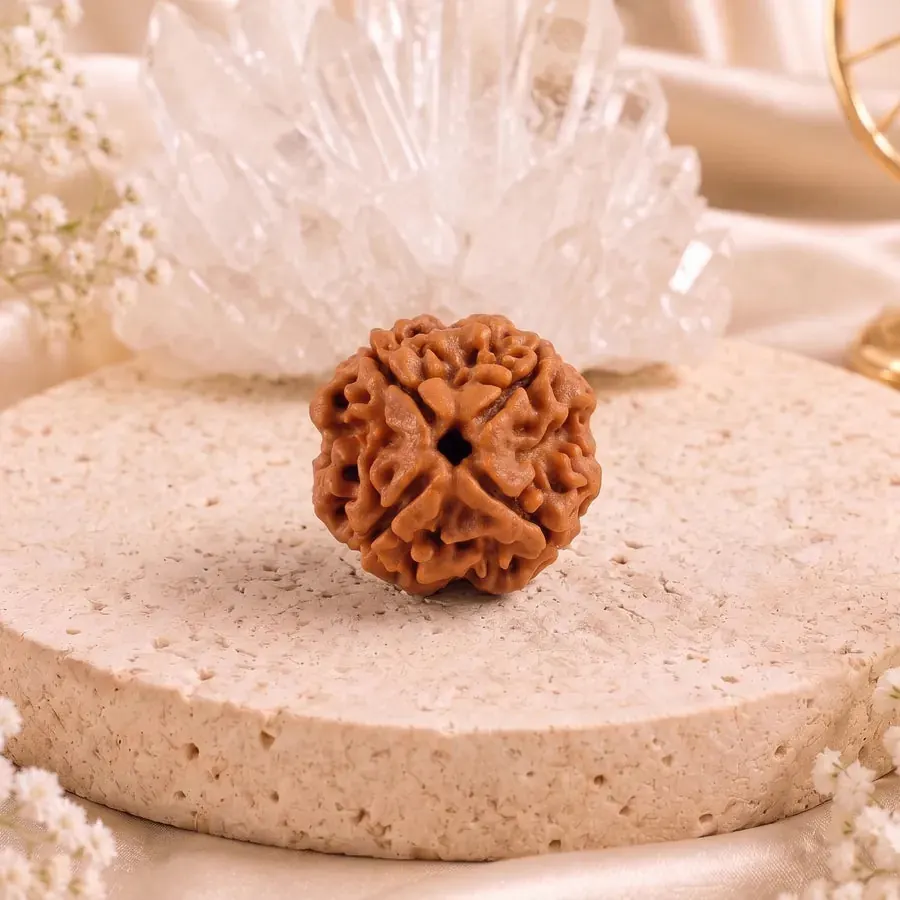
The bead with Brahma's four faces
In the old lists that sort rudraksha by face count, the bead with four natural lines (mukhi) running from end to end is named as a form of Brahma, the creator, whose four faces are linked with the four Vedas. Everything tradition says about 4 mukhi rudraksha benefits follows from that: this is a bead of knowledge and the spoken word, not of wealth or protection. Families speak of clearer thinking, steadier study, and easier expression in speech and writing.
You will also hear it called the char mukhi rudraksha (Hindi) or chatur mukhi (Sanskrit). Many astrologers today add a planetary layer and tie it to Budh (Mercury), the planet of intellect and communication. It is usually started on a Monday or a Wednesday with a short mantra, though texts differ on both, and it does none of the studying for you.
Where Saraswati and Mercury come in
Brahma's link is the oldest of the three you will meet. Puranic lists of rudraksha by face count, such as the one in the Shiva Purana, name the four-faced bead as his form, and since he is said to have spoken the Vedas through his four mouths, the bead's whole character is tied to learning and speech.
Saraswati arrives through household devotion rather than through those lists. As Brahma's consort and the goddess of learning, music and speech, she is often mentioned alongside the bead, but this is a link people make, not a separate rule in the older texts.
Mercury (Budh) is a later, astrological layer. In the common planetary mapping of rudraksha, 4 Mukhi goes with Mercury, the traditional lord of Gemini (Mithuna) and Virgo (Kanya). Some astrologers use other mappings, so treat this as one widely used scheme, not a settled fact. Between them, the three give the bead its reputation: knowledge from Brahma, learning and voice from Saraswati, and reasoning, memory and communication from Mercury.
4 Mukhi rudraksha benefits for students, writers and speakers
Because the bead is about words and attention, the people astrologers and families traditionally suggest it for are easy to predict:
- Students and people preparing for exams or long courses. The tradition speaks of a calmer, more retentive mind. It does not speak of marks, and neither do we.
- Writers, journalists, editors and translators. Work done in language, which Mercury is said to rule.
- Teachers, lecturers and public speakers. People who must explain clearly and think on their feet.
- People in trade, accounts and analysis. In classical reading Mercury is also the planet of calculation and commerce.
- Those whose kundli shows a weak or troubled Mercury. This is the chart-based reason, covered in the next section.
For students there is also a calendar custom. Vasant Panchami, Saraswati's festival, is the day most closely linked with learning in the Hindu calendar, and it falls on 11 February 2027. Some families like to begin wearing a learning-related bead, or start a new subject, on that day. It is a lovely custom, not a requirement; the Vasant Panchami guide explains the puja and the tradition of starting to learn, and the study room vastu guide covers desk direction and light for the space itself.
Is Mercury asking for it? Reading your kundli
You do not need a chart to wear rudraksha, which is generally described as gentle and suitable for anyone. A chart only helps if you want a reason rooted in your own kundli rather than a general list, and for this bead that means looking at Mercury.
- Make your free birth chart on the Astroliya kundli page with your date, time and place of birth.
- Find Budh in the planet table and note its sign and house. The chart marks a retrograde planet with ʀ. Also see whether Mercury shares a house with the Sun: astrologers traditionally read a Mercury very close to the Sun as combust, and so weaker.
- Check which house Mercury rules for your lagna. For Gemini and Virgo ascendants it rules the lagna itself, which makes it central to the whole chart.
- Check the current dasha. A Mercury mahadasha or antardasha is the period when astrologers most often bring up Mercury remedies.
An illustration, not a reading: take a Virgo-ascendant chart with Mercury in the 8th house, close to the Sun, entering Mercury's antardasha. An astrologer in this tradition might suggest a 4 Mukhi bead alongside Mercury's mantra as a simple support for that period. Give the same astrologer a Taurus-ascendant chart with a strong Mercury in the 2nd house and they might see no particular need for it.
If reading the chart feels like a lot, our AI astrologer can walk through your Mercury placement with you, showing the reasoning as it goes.
Counting to four: how a real char mukhi is identified
Four-faced beads are not rare, but they are still faked, commonly by carving extra lines onto a bead with fewer faces or by joining pieces. Four is a small number, though, so the first test is one you can do at the counter. A natural mukhi is a continuous groove from the stem end to the opposite end. Turn the bead slowly and count; a line that stops halfway, looks unusually sharp, or shows a different colour inside is a warning sign.
Next, look at the paperwork, and specifically at what was tested. An X-ray or CT image shows the seed chambers inside, and on a genuine bead their number matches the faces. Our guide to certified rudraksha explains what a lab certificate proves and what it does not.
What you can ignore are the folk "tests". Floating or sinking in water, spinning between copper coins, or "pulling" milk says nothing about authenticity; how to identify original rudraksha lists the checks that do mean something.
The bead in the Astroliya store
Astroliya's own certified 4 Mukhi Nepali bead is a natural Nepali bead with four face lines and, in the listing's words, "comes with a certificate of authenticity". The listing also notes that each natural Nepali bead has its own shape, texture, size and surface, so no two look exactly alike. Other face counts are in the rudraksha beads collection.
Monday or Wednesday: starting to wear it
Sources disagree most on the day and the mantra, so here are the common practices with the differences laid out.
| Question | Common practice | Where texts or teachers differ |
|---|---|---|
| Day | Monday, Shiva's day | Wednesday, Mercury's day, if worn for Budh |
| Time | Morning, after bathing | Some prefer Brahma muhurta, before sunrise |
| Mantra | Om Hreem Namah | Some give Om Namah Shivaya for every bead, or Mercury's beej mantra |
| Count | 108 repetitions on the first day | Some say 9, 11 or 21 times daily after that |
| Thread | Red, yellow or white silk or cotton | Silver or gold capping is also common |
The choice of day is really a choice of emphasis: Monday if you think of the bead as Shiva's, Wednesday if you are wearing it for Mercury. A simple, widely followed first morning goes like this:
- Rinse the bead in clean water (some families use Ganga jal or raw milk first) and let it dry.
- Sit facing east or north, light a lamp if you wish, and hold the bead in your right hand.
- Recite the mantra you have chosen, ideally 108 times. A mala helps you keep count; our guide to mantra japa rules explains how.
- Wear it on a thread around the neck or on the right wrist, so it touches the skin if you like.
You can listen to and practise mantras on the Astroliya mantra page. If your family or teacher gives a different mantra or day, follow theirs; the tradition values regular, sincere practice over any one formula.
Care. Most people take the bead off before sleeping, bathing with soap, swimming or visiting a cremation ground, though practices vary. Wipe it now and then with a dry cloth; a drop of oil every few months keeps the surface from drying out.
Choosing between 4 Mukhi, 5 Mukhi and a crystal
Anyone buying a bead for study or work tends to weigh these three. The table shows how they differ in the tradition; it is not a ranking.
| 4 Mukhi rudraksha | 5 Mukhi rudraksha | Crystal bracelet | |
|---|---|---|---|
| Traditional link | Brahma; Mercury in the common mapping | Shiva as Kalagni Rudra; Jupiter in the common mapping | The stone itself; zodiac pairings in modern practice |
| Usually chosen for | Learning, speech, writing, memory | General calm, japa, everyday wear | Personal style plus a stone's traditional meaning |
| Typical form | Single bead on thread or capped | Bead, mala or bracelet | Bracelet |
| Who it suits | Mercury-focused goals, Gemini and Virgo links | Almost anyone; the common starting bead | Those who prefer a crystal to a seed |
For one all-purpose bead for meditation, the 5 Mukhi guide explains why it is the usual first choice. When the reason is specifically learning or speech, the 4 Mukhi is the traditional answer, and the rudraksha decision guide helps if you are still deciding by goal, rashi or chart. Crystal lovers can browse the zodiac energy bracelets; in the tradition none of them substitutes for a rudraksha. They are simply a different practice.
Limits worth knowing before you buy
A bead of learning attracts more exaggerated claims than most, so it is worth being plain about what it cannot do.
- It does not raise marks, clear an exam or get anyone a job. Study does that; the bead is, at most, a reminder to sit down and do it.
- It does not treat stammering, memory loss, anxiety or any illness. Please see a doctor or therapist for those.
- It does not "fix" a planet. In the tradition, a remedy is a support for the person during a period, not a switch that changes the chart.
- It is not considered risky to wear without a chart reading. Rudraksha is described as suitable for anyone, which is part of why it is so widely worn.
Common questions about the char mukhi bead
Can anyone wear a 4 Mukhi rudraksha?
In most traditions, yes. Rudraksha is generally described as suitable for people of any age, gender or rashi, and the 4 Mukhi bead in particular is often given to children and students. If you follow a particular guru or family practice, ask them first.
Is the char mukhi rudraksha the same as 4 Mukhi?
Yes. Char mukhi, chatur mukhi and four mukhi are different names for the same bead with four natural face lines; the name depends on whether you are speaking Hindi, Sanskrit or English.
Which rudraksha is best for students?
Tradition most often points students to the 4 Mukhi bead because of its link with Brahma, Saraswati and Mercury. Some astrologers also suggest a 6 Mukhi bead for focus, and many students simply wear a 5 Mukhi for general calm. A chart reading can narrow it down, but none of them replaces regular study.
Can I wear 4 Mukhi and 5 Mukhi together?
Yes, combining beads is common, and the 4 and 5 Mukhi pair is a frequent choice for study and meditation. Some string them on one thread, others wear them separately; common practice has no rule against the pairing.
Do I need my kundli before buying one?
No. Because rudraksha is considered gentle, most people wear a 4 Mukhi without a chart. If you want a personal reason, check Mercury's placement and your current dasha in your free kundli first.
From the Astroliya store
Pieces for this guide
Chosen from our own store to go with what you just read.


