

5 Mukhi Rudraksha Benefits: Who Wears It, and Bead, Mala or Bracelet?
Most japa malas are strung from five-faced beads, and rudraksha lists name 5 Mukhi as the bead almost anyone can wear. So the decision that costs money is usually the form, a single bead, a 108-bead mala or a bracelet, and it pays to pick the one you will actually use.
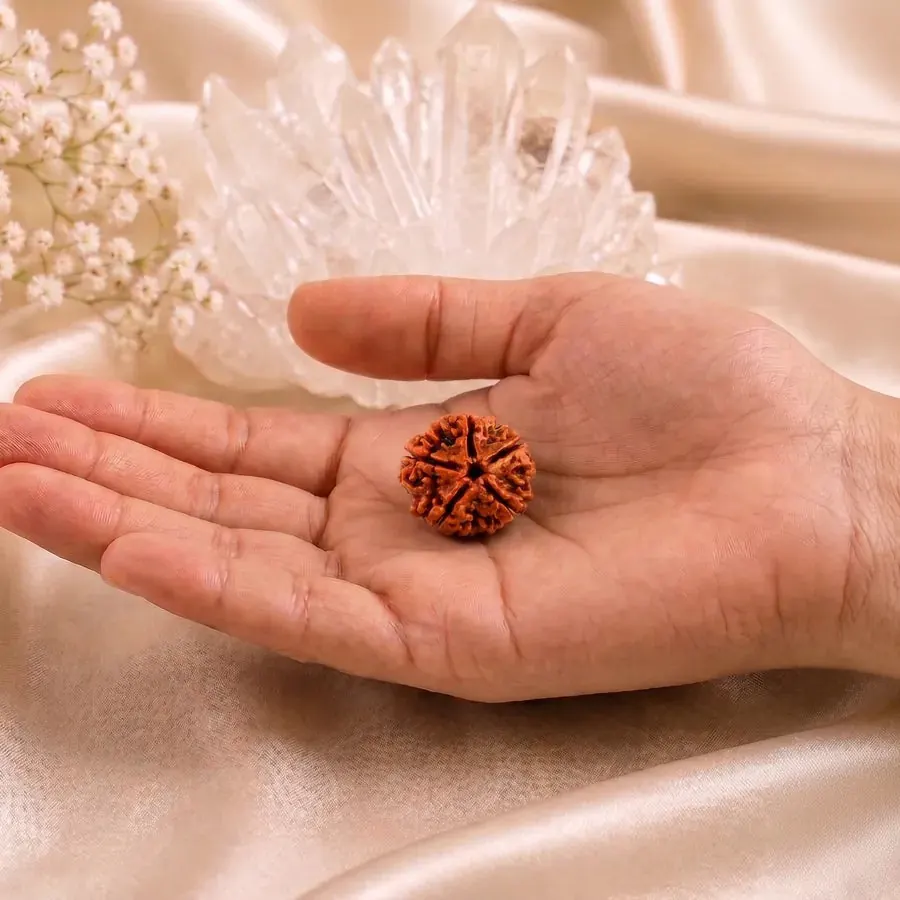
If you are reading about 5 mukhi rudraksha benefits, you have probably noticed that this bead turns up everywhere: on malas, on bracelets, on the necks of people who would not call themselves religious. That is no accident. In the rudraksha tradition the five-faced bead (panch mukhi rudraksha) is the everyday one: the bead most lists say almost anyone can wear, and the bead most japa malas are strung from. Its reputation rests on two threads, an older Shiva association and a later planetary one, and they are worth keeping apart.
5 Mukhi Rudraksha Benefits: What Tradition Says
A mukhi is a natural line running from one end of the seed to the other. A 5 Mukhi bead has five of them. Rudraksha texts and the lists drawn from them connect each count of lines to a deity. The Shiva Purana describes the five-faced bead as Rudra himself under the name Kalagni, a fierce form of Shiva, and most later lists follow it. Many readers also connect the five faces with the five faces of Shiva (Panchanana) and with the five elements, which is one reason the bead is treated as balanced rather than specialised.
Astrologers who pair each mukhi with a planet usually give 5 Mukhi to Jupiter (Guru), the planet of learning, teachers, counsel and dharma. Not every list agrees, and the planet links are a later layer on top of the older Shiva associations, so read them as a convention rather than a fixed rule.
From those two threads come the benefits the tradition usually names:
- Calm and steadiness. The bead is most often described as settling, a reminder to slow down rather than a charm for any one outcome.
- Focus for japa and meditation. Its main use in practice is counting mantras, which is why 108-bead malas are so often made of 5 Mukhi.
- Learning and good counsel. Through the Jupiter link it is traditionally suggested to students, teachers and people who advise others.
- A general spiritual start. Because it is not tied to one specific wish, it is the bead people are told to begin with.
What the tradition does not say, and what we do not say either: that a 5 Mukhi bead will fix your blood pressure, get you a job, win a court case or bring money. Some sellers make those claims. They are not part of the classical associations, and if you have a health concern, please see a doctor.
Who Usually Wears 5 Mukhi, and When Another Mukhi Fits Better
Most lists describe 5 Mukhi as suitable for any age, gender and Moon sign. It is commonly worn by:
- people starting a daily practice of prayer, japa or meditation
- students and teachers, through the traditional Jupiter link
- anyone who wants one bead without first checking a full chart
- people who already chant on a mala and want a matching bead to wear
It is not the only answer, and the usual lists point some goals to a different count. A quick comparison:
| If your main interest is | Tradition often points to | Read more |
|---|---|---|
| A daily practice, calm, learning | 5 Mukhi | This guide |
| Study, memory and speech | 4 Mukhi | 4 Mukhi benefits |
| A steadier approach to money and work | 7 Mukhi | 7 Mukhi benefits |
| Courage, linked with Durga | 9 Mukhi | 9 Mukhi benefits |
| A single, serious devotional bead | 1 Mukhi | 1 Mukhi benefits |
If you are torn between 5 Mukhi and a bead matched to your sign, the first step is knowing your Moon sign (rashi), not your Sun sign. Make your chart free on the kundli page: it shows your rashi and where Jupiter sits, which is what astrologers traditionally look at before suggesting a sign-specific bead. Then compare with rudraksha by zodiac sign or the step-by-step which rudraksha should I wear guide.
Bead, Mala or Bracelet: Which 5 Mukhi Form for Which Use
This is where most buyers get stuck, because the same bead comes in very different forms. The simplest way to decide is by use:
- Wearing one bead daily close to the chest: a single bead on a thread or chain.
- Counting mantras (japa): a 108-bead mala, ideally with a 109th Guru (Sumeru) bead so you know where a round ends.
- Wearing it on the wrist as a reminder through the day: a bracelet. A bracelet is not meant for counting 108 repetitions.
Here are Astroliya's own 5 Mukhi listings on astroliya.store side by side, with each detail exactly as its listing stated it when we read it on 27 October 2026. Where a listing does not state something, the table says so; we have not filled the gap with a guess. Prices change, so check them on the listing.
| Form | Listing | Bead count (as stated) | Bead size (as stated) | Certificate (as stated) | Suits |
|---|---|---|---|---|---|
| Single bead | Original 5 Mukhi Nepali Rudraksha Bead | 1 | Not stated | "comes with a certificate of authenticity" | Wearing one bead daily, or keeping it in the puja space |
| Mala | Astroliya Certified 5 Mukhi Rudraksha Mala | 108 | Approximately 9–10 mm | "comes with a certificate of authenticity" | Japa; the listing does not mention a Guru bead |
| Mala | 5 Mukhi Rudraksha Mala, 108+1 | 108 plus one Guru bead | Approximately 9–10 mm | "comes with a certificate of authenticity" | Japa with a marked start and end; can also be worn |
| Mala | Authentic 5 Mukhi Rudraksha Mala | 108 (in the title) | Not stated for the mala | Its description refers to a single bead and its certificate | Japa; confirm size and certificate with the store first |
| Bracelet | 5 Mukhi Rudraksha Beaded Bracelet, Set of 2 | Two bracelets; beads per bracelet not stated | Not stated | None stated | Wearing on the wrist; not for counting japa |
| Bracelet | Vado Natural Energy Bracelet (its description calls it a 5 Mukhi Rudraksha Bracelet) | One bracelet; beads not stated | Not stated | None stated | Wearing on the wrist; not for counting japa |
Three things stand out. First, only two malas state a bead size, and they state the same range; of those two, only the 108+1 listing states a Guru bead, so that is the one to pick if you want a marked start and end. Second, neither bracelet listing states a certificate, so if a certificate matters to you, it is not the form to pick. Third, a single bead is the only form you can wear under a shirt every day without it being in the way.
The rest of the range, including other mukhis, is in the rudraksha beads collection.
A Worked Example: Choosing by Use
The following is an illustration, not a real customer.
Meera is a second-year college student. Each morning she chants Om Namah Shivaya for one round, and she would also like to wear something during exams. She has never had her chart read.
- Use first. She needs to count 108 repetitions every morning, so she needs a mala. A bracelet will not do this job.
- Start and end of a round. She keeps losing count where the round finishes, so a 108+1 mala with a Guru bead suits her better than a plain 108.
- Wearing during the day. A full mala of 9–10 mm beads is bulky under everyday clothes. She could wear the mala only at home and add a single bead on a thread for the day, or simply carry the mala in a cloth pouch.
- Check the chart, optionally. If she wants to know whether a sign-specific bead is suggested for her, she makes her free kundli first, sees her Moon sign and Jupiter's position, and decides from there.
The point of the example is the order: decide the use, then the form, then the listing. A common mistake is buying the form before deciding the use.
How to Wear a 5 Mukhi Rudraksha
Customs differ from family to family, and none of these steps is compulsory. What astrologers and priests traditionally suggest:
- Day. Monday, the day associated with Shiva, is the usual choice. Some prefer Thursday because of the Jupiter link.
- Cleaning. Rinse the bead in clean water. Some families also dip it in raw milk or Gangajal, then dry it.
- Mantra. The bija mantra most lists give for 5 Mukhi is Om Hreem Namah. Many people simply use Om Namah Shivaya. Chanting it 108 times before first wearing is a common practice. Our guide to mantra japa rules covers how to hold and turn the mala.
- Thread or chain. A cotton or silk thread (red or yellow is traditional) or a silver chain. The bead is usually worn so it rests near the heart.
- When to remove it. Many people take it off for sleep, bathing with soap and visits to a cremation ground, mostly to protect the bead. Treat these as care habits rather than rules with consequences.
For a mala you use for japa, the custom is to keep it for japa only and store it in a cloth pouch. If you are choosing bead size, knotting or 108 against 108+1, read rudraksha mala 108 beads.
Three Checks That It Is a Real 5 Mukhi
A 5 Mukhi is the most common mukhi, so it is less often faked than rare ones, but cracked or damaged beads, carved lines and similar-looking seeds still turn up. Three checks you can do at home:
- Count the lines pole to pole. Each of the five lines should run continuously from one end to the other. Lines that stop halfway or look scratched in are a warning sign.
- Look at the surface between the lines. Natural beads have irregular, rounded bumps that differ bead to bead; very uniform, sharp-edged patterns suggest carving or moulding.
- Read what the paperwork actually claims. A certificate is a reference, not a magic stamp; check whose name is on it and what test it says was done. Our guide to certified rudraksha explains what a certificate can and cannot prove.
Water-floating and copper-coin tests are popular but unreliable. The full list of checks that work and tests that do not is in how to identify original rudraksha. The size and surface differences between Nepali and Indonesian beads are in Nepali vs Indonesian rudraksha.
Myths and Side Effects, Answered Plainly
- "Only men can wear it." Many traditions today say anyone may wear rudraksha. Some families keep their own customs, such as removing it at certain times, and that is a family choice.
- "It must be energised by a priest first." A puja is a traditional option, not a requirement in most lists. Washing the bead and chanting yourself is the common practice.
- "Wearing the wrong bead brings bad luck." The classical associations do not describe 5 Mukhi this way, and it is the bead most often described as suitable for everyone. If wearing it makes you anxious, take it off; it was meant to calm, not to worry.
- "Side effects" like headaches or restlessness. There is no good evidence that a rudraksha seed causes these. If a thread or bead irritates your skin, remove it, and if symptoms continue, see a doctor rather than changing beads.
- "It heals illness." It does not. No rudraksha treats any illness.
Questions people ask
Can I wear a 5 Mukhi rudraksha without checking my kundli?
Most lists say yes, which is why it is the usual first bead. If you want a sign-specific bead instead, make your free kundli to see your Moon sign and Jupiter's placement, or ask Astroliya's AI astrologer to read the calculated chart with you.
Which is better, a 5 Mukhi rudraksha mala or a bracelet?
They do different jobs. A 108-bead or 108+1 mala is for counting japa; a bracelet is for wearing through the day and is not meant for counting. If you do japa, start with the mala.
Is panch mukhi rudraksha the same as 5 Mukhi?
Yes. Panch is the Hindi word for five (pancha in Sanskrit), so panch mukhi, five mukhi and 5 Mukhi all name the same five-lined bead.
What is the Guru bead on a 108+1 mala?
It is the extra bead, also called Sumeru, that marks the start and end of a round. When you reach it during japa, you turn the mala and count back rather than crossing it.
Is there a Hindi version of this guide?
Yes: 5 मुखी रुद्राक्ष के फायदे covers the same choices in Hindi.
From the Astroliya store
Pieces for this guide
Chosen from our own store to go with what you just read.


