

Nepali vs Indonesian Rudraksha: Size, Surface and What Actually Differs
Is a Java bead a lesser rudraksha? Both come from the same kind of Elaeocarpus tree, and the label only says where a bead grew: not whether it is genuine, and not how much it can do for you.
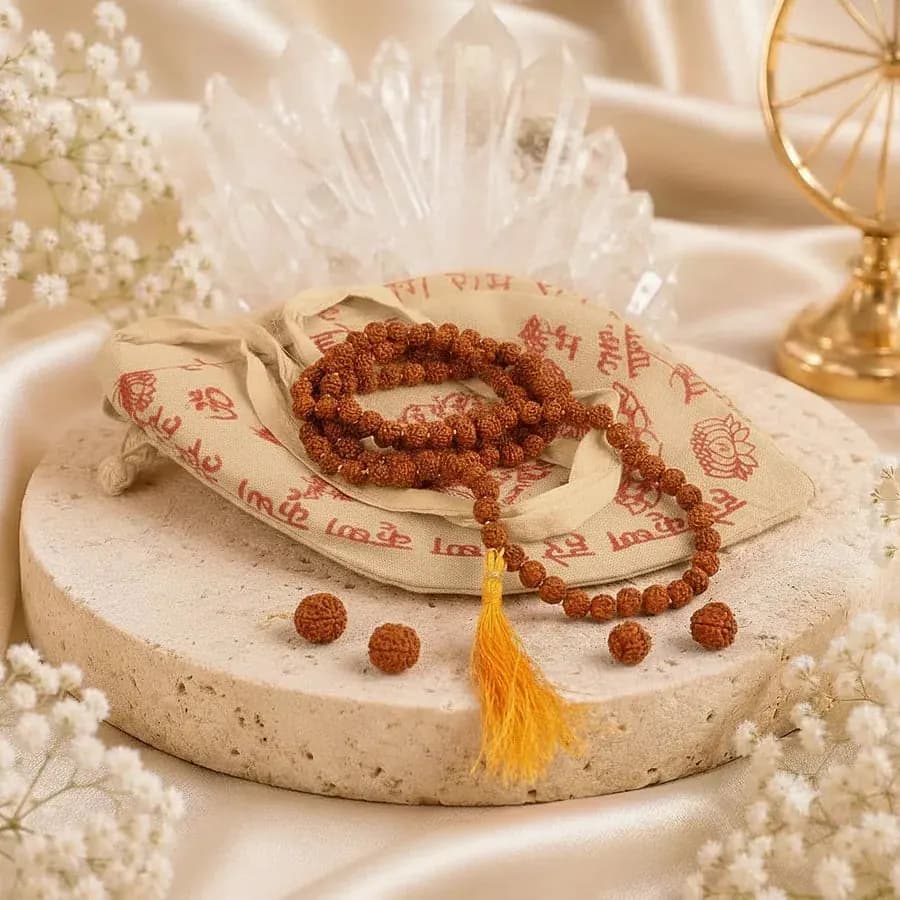
Quick answer: Nepali vs Indonesian rudraksha
The Nepali vs Indonesian rudraksha question comes down to three visible things: size, surface relief and how easy the mukhis (the natural lines running from top to bottom) are to count. Beads sold as Nepali are usually the larger ones, with deep grooves and raised, well-separated faces. Beads sold as Indonesian, often called Java rudraksha, are usually smaller, smoother and more even in shape, with finer lines. Both are the stones of the same kind of tree. Neither name tells you a bead is genuine, and the classical tradition does not rank one origin as more powerful than the other.
If you remember one thing: choose by what you can check (the mukhi count, the condition of the bead and an honest description), and by how you plan to wear it, not by the country on the label.
Same tree, two growing regions
A rudraksha bead is the cleaned stone (the hard inner pit) of the fruit of an Elaeocarpus tree. Botanists note that more than one Elaeocarpus species may supply the trade, and that the main species grows across a wide arc, from the Himalayan foothills of Nepal and India, east through Southeast Asia, and south to the islands of Indonesia (Wikipedia: Elaeocarpus angustifolius). The same source records that the stones have long been traded from ports in Java, Madura and Bali, where they were known as ganiter or ganitris, which is why "Java rudraksha" is still a common label in India.
The fruit is a bright blue or purple drupe. Inside, the stone is divided into segments, each of which usually holds a seed. Those segments show on the outside as the grooves that become the mukhis. So a 5 Mukhi bead from Nepal and a 5 Mukhi bead from Java are, botanically, the same kind of object. What differs is how big the stone grew and how sharply its surface formed, and growing conditions shape both.
Side by side: the comparison table
The table below describes how beads are commonly described in the trade, not a measurement of every bead. Natural stones vary: you will find small Nepali beads and well-formed Indonesian ones. Treat it as a guide to what to look for, and trust the listing in front of you over any general rule.
| Sold as Nepali | Sold as Indonesian (Java) | |
|---|---|---|
| Where it grows | Himalayan foothills of Nepal and neighbouring India | Islands of Indonesia, chiefly Java |
| Typical size | The larger beads in the market; pendant-sized pieces are common | Usually smaller; the familiar size for dense malas |
| Surface relief | Deep grooves, raised and rugged faces | Smoother, flatter, more even surface |
| How the mukhis show | Lines are wide and usually easy to count by eye | Lines are fine and close; a lens or good light helps |
| Shape | Rounder to irregular, each bead visibly different | More uniform from bead to bead |
| Common use | Single beads, pendants, bracelets, larger malas | Malas and bracelets where many matching beads are needed |
| Weight in the hand | Heavier per bead because it is bigger | Lighter, which suits long malas worn every day |
| What it proves about authenticity | Nothing on its own | Nothing on its own |
One point from the botanical record is useful here. Many stones strung into garlands are small, around 7 mm, while specimens kept in museum collections are larger, 10 mm and up (Wikipedia). In other words, small beads are not unusual or suspicious. They are simply what most malas have always been made of.
How clearly the mukhis show, and why it matters
The mukhi count is the one fact everything else depends on: it decides which deity, planet and mantra the tradition links to the bead. So the most practical difference between the two origins is not power but legibility.
On a larger bead with deep grooves, you can usually count the lines with the naked eye, turning the bead slowly from its top (where the stalk was) to its base. On a small bead with fine lines, two neighbouring lines can sit so close that a count goes wrong by one, and a shallow line can be mistaken for a crack, or a crack for a line.
Here is a worked illustration. Suppose you are holding two beads both described as 5 Mukhi. The larger one shows five broad channels you can trace with a fingernail. The smaller one shows lines you can only follow in daylight with a magnifying glass, and one of them seems to fade halfway down. That second bead may still be a perfectly genuine 5 Mukhi. It just needs more care to confirm, and for a higher mukhi count, where a single extra line changes the bead's identity, an X-ray or a lab report is the clearer answer. Our guide on how to identify original rudraksha walks through the checks that work, and the ones (like the water test) that don't.
Is one more powerful? What tradition says
You will read that Nepali beads are "more powerful" or "more energetic" than Indonesian ones. The classical texts that describe rudraksha, such as the Shiva Purana and the Rudraksha Jabala Upanishad, classify beads by the number of mukhis, and some passages also speak of colour and size. They do not rank Nepal above Java, or the reverse. Modern national borders did not exist when those texts took shape, and the tradition's own test is whether a bead is whole, natural and correctly identified.
Size is the one place where honesty needs a little more detail. The Shiva Purana does grade beads by size: one as large as an amla fruit is called the best, one the size of a jujube middling, and one the size of a chickpea inferior (Bibek Debroy's notes on his Shiva Purana translation). Because Nepali beads are usually the bigger ones, sellers sometimes stretch that verse into "Nepali is better". But the grading is about the bead in your hand, not the land it grew in: a large Indonesian bead and a small Nepali one would sit on opposite sides of it.
So the honest position is this:
- Tradition links meaning to the mukhi count, and to a bead being natural and undamaged.
- Where a classical text grades size, it grades the bead, not its country of origin. Many people also choose smaller beads for a long japa mala simply because they are lighter to use.
- No claim that one origin works better than another can be checked, and nobody can show it to you.
- Whatever a bead is traditionally said to support, it is a companion to practice, not a substitute for medical, legal or financial advice.
If someone tells you an Indonesian bead "won't work" or that a Nepali bead will change your luck by itself, treat that as a sales line, not as the tradition.
Why Nepali beads usually cost more
We don't quote prices here because they change, but the reasons behind the gap are easy to follow. Size is the first: larger beads are what most people want for a pendant, and the classical size grading above adds to their appeal. Legibility is the second: a bead whose mukhis can be counted at a glance is easier to sell with confidence, and easier to certify. Demand is the third: the "Nepali" label itself carries a reputation, and that reputation is priced in.
What the price does not tell you is whether the bead is genuine. An expensive bead can be a carved fake, and an inexpensive Java mala can be entirely natural. If a higher mukhi count is quoted at a price that seems too good, or the description promises results, be careful whatever the origin. Our explainer on certified rudraksha covers what a lab certificate proves and what it doesn't.
Which suits a mala, a pendant or daily wear
Think about how the bead will live with you before you think about where it grew.
- A single bead or pendant. A larger bead with clear faces is easier to identify, sits well on a thread or chain and is easy to inspect later. This is where Nepali beads are most often chosen.
- A japa mala for counting. You will move 108 beads through your fingers again and again, so weight and evenness matter. Smaller beads keep a long mala light; larger ones give a firmer feel under the thumb. Both are traditional. Our guide to the rudraksha mala with 108 beads covers bead size, 108 or 108+1, and knotting.
- A bracelet worn all day. Smaller beads catch less on sleeves and desks. If you prefer larger beads, check that the thread and spacing are comfortable.
- A specific mukhi count. Choose the bead whose count you can confirm most easily, which often means a larger bead or one with a clear report.
Whichever you pick, the care is the same: keep it dry after bathing, clean the grooves gently with a soft brush, and oil it occasionally if your tradition does so.
What Astroliya stocks, and why we say so
Every rudraksha bead and pendant on Astroliya's store that names an origin names Nepal, and we sell no beads described as Indonesian. A few of our malas, and our bracelets, do not state an origin at all, and we would rather point that out than let you assume it.
Here is what the listings themselves say about size, with nothing added:
- The Astroliya Certified 5 Mukhi Rudraksha Mala has 108 beads, and its listing describes them as approximately 9–10 mm, with a certificate of authenticity.
- The Certified 8mm Rudraksha Mala has 108+1 hand-knotted beads of 8 mm, and its listing says each mala comes certified.
- None of our single beads or pendants states a size. Several, such as the 4, 6 and 7 Mukhi pieces, describe themselves as Nepali and say each natural bead has its own shape, texture, size and surface characteristics.
Certificate wording also differs from listing to listing: some say "certificate of authenticity", some "lab certified", one says "lab tested". Read the words on the page you are buying from rather than assuming the whole range is described the same way. You can browse every strand in the rudraksha malas collection.
A short buyer's checklist
- Decide the mukhi count first, then the form (bead, pendant, mala or bracelet).
- Count the lines yourself in daylight, top to base, and use a lens on small beads.
- Look for cracks, filled holes, glued joints and lines that stop or change depth.
- Read the listing for a stated size and origin, and for what the certificate actually covers.
- Ignore any promise of a specific result. The tradition doesn't make one, and neither should a seller.
If you are unsure which mukhi the tradition links to your own chart, you can make your free kundli first, or ask an AI astrologer to talk through the options with your chart in view. More guides sit under rudraksha articles.
Questions people ask
Is Indonesian rudraksha fake?
No. Indonesian or Java rudraksha comes from the same kind of tree and is a natural seed when sold honestly. Fakes exist in both origins, usually carved wood, moulded resin or a lower mukhi bead with extra lines cut in. The origin label tells you nothing either way; the checks on the bead do.
Which is better, Nepali or Indonesian rudraksha?
Neither is better in the classical tradition, which reads beads by mukhi count, not by country. Nepali beads are usually larger with clearer lines, which makes them easier to identify and popular for pendants. Indonesian beads are usually smaller and lighter, which makes them practical for long malas.
How can I tell a Nepali bead from an Indonesian one?
Size and surface give a strong hint: larger, deeply grooved, rugged beads are typically sold as Nepali, and small, smooth, uniform beads as Indonesian. But there is no simple home test that proves where a bead grew. If origin matters to you, buy from a seller who states it on the listing and documents it.
Is Java rudraksha the same as Indonesian rudraksha?
Yes, in everyday use the two names mean the same thing. Java is the Indonesian island long associated with the trade, and "Java rudraksha" has become a common shorthand in India for beads from Indonesia generally.
Does the size of a rudraksha change its effect?
The Shiva Purana does grade beads by size, calling an amla-sized bead the best and a chickpea-sized one inferior, so the tradition does give size some weight. That grading is about the bead, not whether it came from Nepal or Java. No claim that a bigger bead does more can be checked, so choose a size you can identify clearly and will actually wear.
From the Astroliya store
Pieces for this guide
Chosen from our own store to go with what you just read.


