

9 Mukhi Rudraksha Benefits: Durga, Courage and the Navratri Connection
Nine faces, nine forms of Durga, nine nights of Navratri: the number explains most of this bead's reputation. Many astrologers add a second link, to Ketu. This guide keeps the devotional reading and the astrological one apart, gives the 2027 Navratri dates people often start on, and shows how to check both the bead and your own chart before buying.
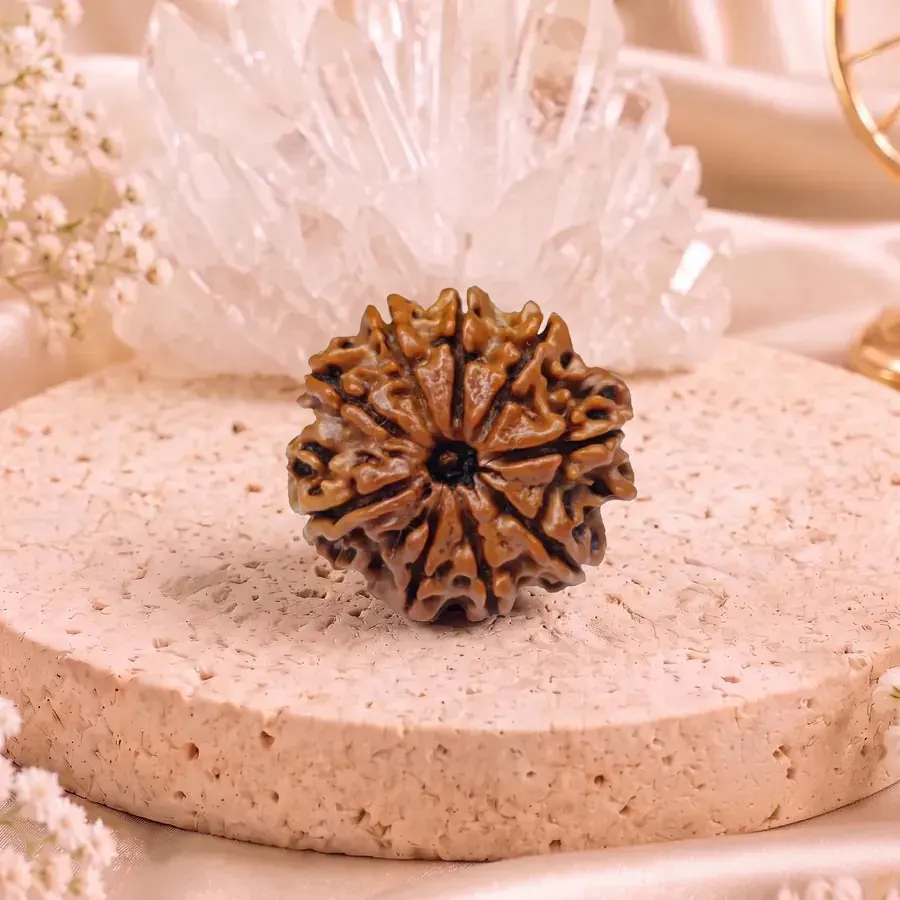
Count the faces on this bead and you arrive at the number of Durga's forms worshipped across Navratri. That one fact shapes most of the 9 mukhi rudraksha benefits the tradition describes: courage when fear is loud, steadiness under pressure, and a sense of being held by the goddess. In Hindi it is usually called the nau mukhi rudraksha, and a genuine one has nine natural face lines (mukhi) running unbroken from end to end. In the planetary scheme many astrologers use, it is also tied to Ketu, the south node of the Moon.
Those two links, one devotional and one astrological, explain who reaches for it. Durga's devotees wear it as part of their worship; people in a Ketu period are often pointed to it as a gentle support; and Navratri, which comes twice a year, is when most of them begin. It is not a shield against real-world harm, and it stands in for no doctor, lawyer or financial adviser.
Shailaputri to Siddhidatri: why nine faces mean Durga
Nine is Durga's number. Each of the nine nights of Navratri honours one of her forms, the Navadurga, in this order: Shailaputri, Brahmacharini, Chandraghanta, Kushmanda, Skandamata, Katyayani, Kalaratri, Mahagauri and Siddhidatri. A bead with nine faces is read as holding all nine at once, which is why it is called Durga's bead and associated with Shakti, the goddess's power.
That reading dominates today, but it is not the only one. Some older Puranic lists that assign a deity to each face count name others for the nine-faced bead, Bhairava among them. So the Durga link is best taken as the prevailing devotional reading rather than a single fixed answer.
Where Ketu comes in
Pairing each face count with a planet is a later, astrological layer, and teachers do not all use the same table. In the most common one, 9 Mukhi goes with Ketu and 8 Mukhi with Rahu; other astrologers map them differently. "9 mukhi rudraksha for Ketu" is therefore one widely used scheme, not a settled rule.
The pairing makes sense once you know Ketu's character. In Parashari astrology Ketu is a shadow planet: detached, spiritual and sudden, associated with loss, separation and moksha. Its periods are often described as unsettling, a time when things end or shift without much warning. Durga worship is a traditional recommendation for hard Ketu phases, so a bead that carries both associations sits naturally there.
9 mukhi rudraksha benefits, read honestly
Lists of benefits for this bead tend to repeat the same five claims. Each has a reasonable meaning inside the tradition and a reading it cannot bear.
| Traditional description | What people mean by it | What it does not mean |
|---|---|---|
| Courage and fearlessness | Steadier nerves, less hesitation before hard decisions | That you will not feel fear, or that risk goes away |
| Protection | Feeling held by the goddess in a difficult period | Physical, legal or financial protection of any kind |
| Calming a Ketu period | A devotional focus during a restless or confusing phase | That a Ketu dasha's events are cancelled or changed |
| Energy and willpower | Shakti, the goddess's strength, as an inner quality | A treatment for fatigue, illness or low mood |
| Spiritual progress | Steadier japa and meditation, especially for Devi devotees | A shortcut past the practice itself |
Read down the right-hand column and one idea repeats: the bead is described as backing the wearer's own effort and devotion, never as acting on the world by itself.
The people astrologers usually suggest it to
Families and astrologers tend to name the same groups:
- Devotees of Durga, or of the goddess in any form. For them it is a devotional object first, worn as part of their worship.
- Anyone in a Ketu mahadasha or antardasha. In the Vimshottari dasha system Ketu's mahadasha runs seven years, and a Ketu antardasha falls inside every other mahadasha. Ketu remedies come up most in these periods.
- People with a troubled Ketu in the chart. Ketu with the Moon, said to unsettle the mind, is a common example, as is Ketu in a house that weighs heavily for the person, such as the 1st, 4th or 7th.
- People born with the Moon in Ketu's nakshatras. Ketu rules Ashwini, Magha and Mula, and some astrologers suggest the bead to those whose Moon sits in one of them.
- Someone about to do something that takes nerve. Starting a venture, moving, having a difficult conversation. The tradition talks about courage, not about how things turn out.
There is a timely reason the question is coming up, too. Ketu enters Cancer on 5 December 2026 and stays until mid-2028, with Rahu opposite in Capricorn. Our Rahu-Ketu transit guide sets out how that period is traditionally read for each moon sign. Since a transit touches everyone in some way, it is not on its own a reason to buy a bead.
Before buying for Ketu, find Ketu in your kundli
Rudraksha is widely described as gentle and fit for anyone, so a chart reading is not a precondition for wearing a 9 Mukhi. If Ketu is your reason, though, it is worth seeing where your own Ketu sits.
- Make your free birth chart on the Astroliya kundli page using your date, time and place of birth.
- Locate Ketu in the planet table. Note its sign, its house, and any planets with it or directly opposite (with Rahu).
- Check your Moon's nakshatra. Ashwini, Magha or Mula means your first dasha at birth was Ketu's.
- Look at your current mahadasha and antardasha. A Ketu period, or the period of a planet sitting with Ketu, is the usual setting for a Ketu remedy.
An illustration, not a reading: picture a chart with Ketu beside the Moon in the 4th house, its owner entering Ketu's antardasha within a Saturn mahadasha. An astrologer of this school might suggest a 9 Mukhi bead, Durga worship and regular japa as a simple support for those months. In a different chart, with Ketu quiet in the 12th and a Venus period running, the same astrologer might see no special need for it.
If you would rather not work through the chart alone, our AI astrologer can read where Ketu sits in your kundli and explain the reasoning step by step. It is an AI working from your calculated chart, not a person, and any remedy it mentions stays optional.
Starting on a Navratri: the 2027 dates
Since the bead is Durga's, Navratri is the favourite time to start wearing it. Drik Panchang's 2027 calendar (New Delhi; check your city) gives two main Navratris:
| Navratri | Begins | Why people choose it |
|---|---|---|
| Chaitra Navratri | 7 April 2027 | The spring Navratri, which also opens the Hindu new year in much of North India |
| Sharad Navratri | 30 September 2027 | The autumn Navratri, the most widely celebrated, ending in Dussehra |
Customs differ within the nine days. Some families begin on Pratipada, the first day, after Ghatasthapana. Others wait for Ashtami or Navami, the days of Kanya Puja and the closing worship, and a few pick the day of the particular form of Durga they are devoted to. Ghatasthapana and tithi timings shift with location, so go by a local panchang for your city rather than a national time. Our Navratri 2027 guide covers the nine days, Ghatasthapana and the form of the goddess for each day.
None of this is compulsory. If you want to start before the next Navratri, common practice treats any auspicious day as fine, with Tuesday (linked to Durga and Mars) and Friday (linked to the goddess generally) the usual picks.
Om Hreem Hum Namah and the rest of the wearing ritual
Teachers vary on the details. The common practice, and where it differs:
| Question | Common practice | Where teachers differ |
|---|---|---|
| Mantra | Om Hreem Hum Namah, the mantra most lists give for this bead | Some use Durga's mantra or Om Namah Shivaya; follow your teacher if you have one |
| Count | 108 times on the first day | Some say 9 times daily after that, for the nine forms |
| Day | A Navratri day, or a Tuesday or Friday | Some families prefer Monday, Shiva's day, for any rudraksha |
| How worn | Pendant at the neck, close to the heart | Some wear it on the left wrist |
| Thread | Red silk or cotton, the colour of the goddess | Silver or gold capping is common for pendants |
On the first day, a simple sequence:
- Rinse the bead in clean water and let it dry.
- Sit before an image of Durga, or face east, and light a lamp if you like.
- Hold the bead and recite the chosen mantra 108 times. A mala keeps the count; our guide to mantra japa rules explains how to use one.
- Offer a flower or a red cloth if that is your family's custom, then put the pendant on.
Of all these, the mantra deserves a second opinion. Om Hreem Hum Namah is the one most often given, but if your guru, family priest or community uses a different one, the tradition puts more weight on that and on steady practice than on any single formula. The Astroliya mantra page is there if you want to practise.
Care. Many people take the bead off before sleeping, bathing with soap or swimming, though habits vary. Wiping it with a dry cloth and a drop of oil every few months stops the surface drying out.
Counting nine lines: how fakes are made and caught
Nine-faced beads turn up less often than five-faced ones, and that scarcity is what invites forgery. The two usual tricks are carving extra grooves into a bead with fewer natural faces and gluing pieces together into one bead.
Your eye catches the first trick if you are patient. A natural mukhi is one continuous groove from the stem end to the far end, and nine is a lot to count on a small bead, so turn it under good light and mark the line you started from. Grooves that stop short, look freshly cut or show a different colour inside are warning signs.
The second trick, and anything your eye misses, needs a lab. An X-ray or CT image shows the seed chambers inside, and their number should match the faces outside. Our guide to certified rudraksha covers what such a certificate shows and what it leaves out.
Skip the folk tests: floating or sinking in water, spinning between two coins, or turning milk a different colour prove nothing either way. How to identify original rudraksha covers the checks that do hold up.
What the Astroliya 9 Mukhi pendant listing says
Astroliya's Nepali 9 Mukhi rudraksha pendant is, in its listing's words, "sourced directly from Nepal" and "fully certified to ensure its natural origin and quality", and the listing calls the bead "known as the symbol of Goddess Durga".
Read those claims the way you would read any seller's. A certificate can confirm that a bead is natural and how many faces it has, but no lab test shows which country a bead grew in, so ask the store what the certificate records and how origin was established. If you want to compare other face counts set as pendants, see the rudraksha pendants collection.
9, 8 or 5 Mukhi: matching the bead to the reason
Courage and devotion to Durga point to the 9 Mukhi. General calm and a daily japa habit usually point to a 5 Mukhi, the bead most people start with. If the worry in your chart is Rahu rather than Ketu, the common mapping sends you to the 8 Mukhi. Our rudraksha decision guide works through the choice by goal, rashi and chart, so a list alone is not making the decision.
Short answers on the nau mukhi bead
Can anyone wear a 9 Mukhi rudraksha?
In most traditions, yes. Rudraksha is generally described as suitable regardless of age, gender or rashi, and wearing a 9 Mukhi without a chart reading is not considered harmful. If you follow a guru or a family practice, ask them first.
Is the 9 mukhi rudraksha for Ketu or for Durga?
Both, from different layers of the tradition. The Durga link is devotional and comes from the nine forms of the goddess. The Ketu link comes from the planet-to-bead mapping many astrologers use, which is newer and not uniform across teachers.
Should I start wearing it on the first day of Navratri?
Many families do, after Ghatasthapana on Pratipada; others begin on Ashtami or Navami. In 2027 Chaitra Navratri begins on 7 April and Sharad Navratri on 30 September (New Delhi; check your city). It is a popular custom, not a rule.
Can I wear 9 Mukhi with other rudraksha beads?
Yes, combining beads is common. People concerned with both Rahu and Ketu often wear the 8 and 9 Mukhi together, and many add a 5 Mukhi. There is no general rule against combining them.
Will it remove the effects of a Ketu dasha?
No. In the tradition a remedy supports a person through a period; it does not change the chart or cancel what the period brings. Treat it as a devotional focus, and look at your own Ketu placement in your free kundli for context.
From the Astroliya store
Pieces for this guide
Chosen from our own store to go with what you just read.


