Gand Mool Nakshatra: The Six Birth Stars, What Tradition Says, and What It Doesn't
A pandit has said your newborn was born in gand mool nakshatra: should you worry? The label records only that the Moon sat in one of six nakshatras at birth. It is not a forecast of the child's health, character or future.
A gand mool nakshatra birth is one where the Moon, at the moment a child is born, sits in one of six particular nakshatras (lunar mansions): Ashwini, Ashlesha, Magha, Jyeshtha, Moola or Revati. Classical texts set these six apart because each one touches a point where a water sign ends and a fire sign begins. You may also see it written as gandmool nakshatra or simply gandmool. Families often hear the term from a pandit or a grandparent soon after a birth, usually with a recommendation for a shanti ritual.
That is all the label is: a note about where the Moon was. It is not a forecast about a child's health, character or future, and nothing in the calculation looks at any of those things. To check it yourself you need only the Moon's nakshatra and pada at birth, which Astroliya's free kundli shows from the date, time and place.
What "gand mool" means: where water signs meet fire signs
The zodiac in Vedic astrology is divided two ways at once: into 12 signs (rashis) of 30 degrees each, and into 27 nakshatras of 13 degrees 20 minutes each. Most of the time the two grids do not line up neatly. At three points in the circle they do, and both a sign and a nakshatra end on the same line:
- Cancer (water) ends and Leo (fire) begins: Ashlesha ends, Magha begins.
- Scorpio (water) ends and Sagittarius (fire) begins: Jyeshtha ends, Moola begins.
- Pisces (water) ends and Aries (fire) begins: Revati ends, Ashwini begins.
Classical texts call these knots gandanta, from "ganda" (a knot or joint) and "anta" (end). The image is of water turning into fire: an element ending and a very different one starting. "Mool" (root) is often linked to Moola, the nakshatra that begins at the Scorpio to Sagittarius junction, and the phrase "gand mool" came to cover all six nakshatras that sit on either side of the three knots.
There is a second pattern too. Each junction pairs a nakshatra ruled by Mercury (on the water side) with one ruled by Ketu (on the fire side). Astrologers traditionally point out that the cycle of nakshatra lords runs out at Mercury and restarts at Ketu at exactly these three points, which is another way of saying "a cycle closes and a new one opens here".
Gand mool nakshatra list: the six birth stars at a glance
The table lists each nakshatra, the sign it falls in, its ruling planet, the side of the junction it sits on, and the four naming syllables traditionally tied to its four padas (quarters).
| Nakshatra | Sign and span | Lord | Side of the junction | Naming syllables (padas 1 to 4) |
|---|---|---|---|---|
| Ashwini | Aries, 0° to 13°20' | Ketu | Start of the fire sign | Chu, Che, Cho, La |
| Ashlesha | Cancer, 16°40' to 30° | Mercury | End of the water sign | Di, Du, De, Do |
| Magha | Leo, 0° to 13°20' | Ketu | Start of the fire sign | Ma, Mi, Mu, Me |
| Jyeshtha | Scorpio, 16°40' to 30° | Mercury | End of the water sign | No, Ya, Yi, Yu |
| Moola | Sagittarius, 0° to 13°20' | Ketu | Start of the fire sign | Ye, Yo, Bha, Bhi |
| Revati | Pisces, 16°40' to 30° | Mercury | End of the water sign | De, Do, Cha, Chi |
The padas tradition stresses
Each nakshatra has four padas of 3 degrees 20 minutes. Many astrologers give the most weight to the pada that actually touches the junction: the last pada of Ashlesha, Jyeshtha and Revati, and the first pada of Ashwini, Magha and Moola. A birth in a pada further from the knot is often treated as milder, or not counted at all.
Texts and regional customs differ here, sometimes a lot. Some lists assign each pada of Moola or Jyeshtha to a particular relative, some narrow gandanta to a much smaller arc than a full pada, and some families treat any birth in the six nakshatras the same way. If two people give you different answers, it is usually because they follow different versions of the rule, not because one of them has found something alarming in the chart.
Was my baby born in gand mool? How to check
The check uses the Moon's position only, and it takes a minute once you have a chart.
- Make a kundli on Astroliya's kundli page with the date, time and place of birth. If you are new to this, our guide to making a kundli by date of birth explains what each detail is for.
- Find the Moon's nakshatra. Astroliya shows it in the chart summary, with the pada underneath, and again in the planet table.
- Compare it with the six names above. If it is not one of them, the birth is not a gand mool birth, and you can stop here.
- If it is one of them, note the pada. Last pada of Ashlesha, Jyeshtha or Revati, or first pada of Ashwini, Magha or Moola, puts the Moon right at a junction; the other padas are further away.
- If the Moon is close to a nakshatra or pada boundary, check how exact the recorded birth time is (more on that below).
Why the birth time matters near a boundary
The Moon moves through roughly one nakshatra a day, a little faster or slower depending on where it is in its orbit, which works out to about half a degree an hour. A pada is 3 degrees 20 minutes wide. So if the Moon is in the middle of a pada, being out by an hour on the birth time changes nothing. If it sits within a degree or so of a boundary, a time that is off by an hour or two can move it into the next pada, or out of a gand mool nakshatra altogether.
Use the time from the hospital record or birth certificate, not a family member's memory of it. If the time is genuinely unknown, the honest answer is that the nakshatra may be uncertain on days when it changed.
Two worked examples
These are illustrations, not real charts.
- Moon at 28° Cancer. That is Ashlesha, pada 4 (which runs from 26°40' to 30°): the pada right at the Cancer to Leo junction. In most traditions this is the case the shanti is recommended for.
- Moon at 21° Cancer. Still Ashlesha, but pada 2 (20° to 23°20'), several degrees from the junction. Some families would still do a shanti, many astrologers would call it mild, and some would not count it at all.
Today's nakshatra and the arithmetic of gand mool
If you are expecting a baby, or just curious, the panchang shows today's nakshatra with the time it ends, and its month calendar lists a nakshatra against each day. Keep in mind that a nakshatra does not change at midnight or at sunrise; it changes whenever the Moon crosses the line, at any hour. A panchang day marked Moola may begin in Jyeshtha, so a birth on that date is not automatically a Moola birth. The kundli, which uses the exact minute, is what settles it.
We have not published a list of gand mool dates for 2027. Those windows need precise Moon entry and exit times, and we would rather send you to the panchang for the day you care about than print dates we have not computed and checked ourselves.
The arithmetic also helps put the label in proportion. Six of the 27 nakshatras are gand mool, and the Moon passes through all 27 in a little over 27 days. Roughly two days in every nine, then, the Moon is in one of these six. About two in every nine births, then, fall in a gand mool nakshatra by the broad six-nakshatra count, and far fewer if only the junction padas are counted. Most families who check find it is far more common than the worry around it suggests.
What families traditionally do: gand mool shanti
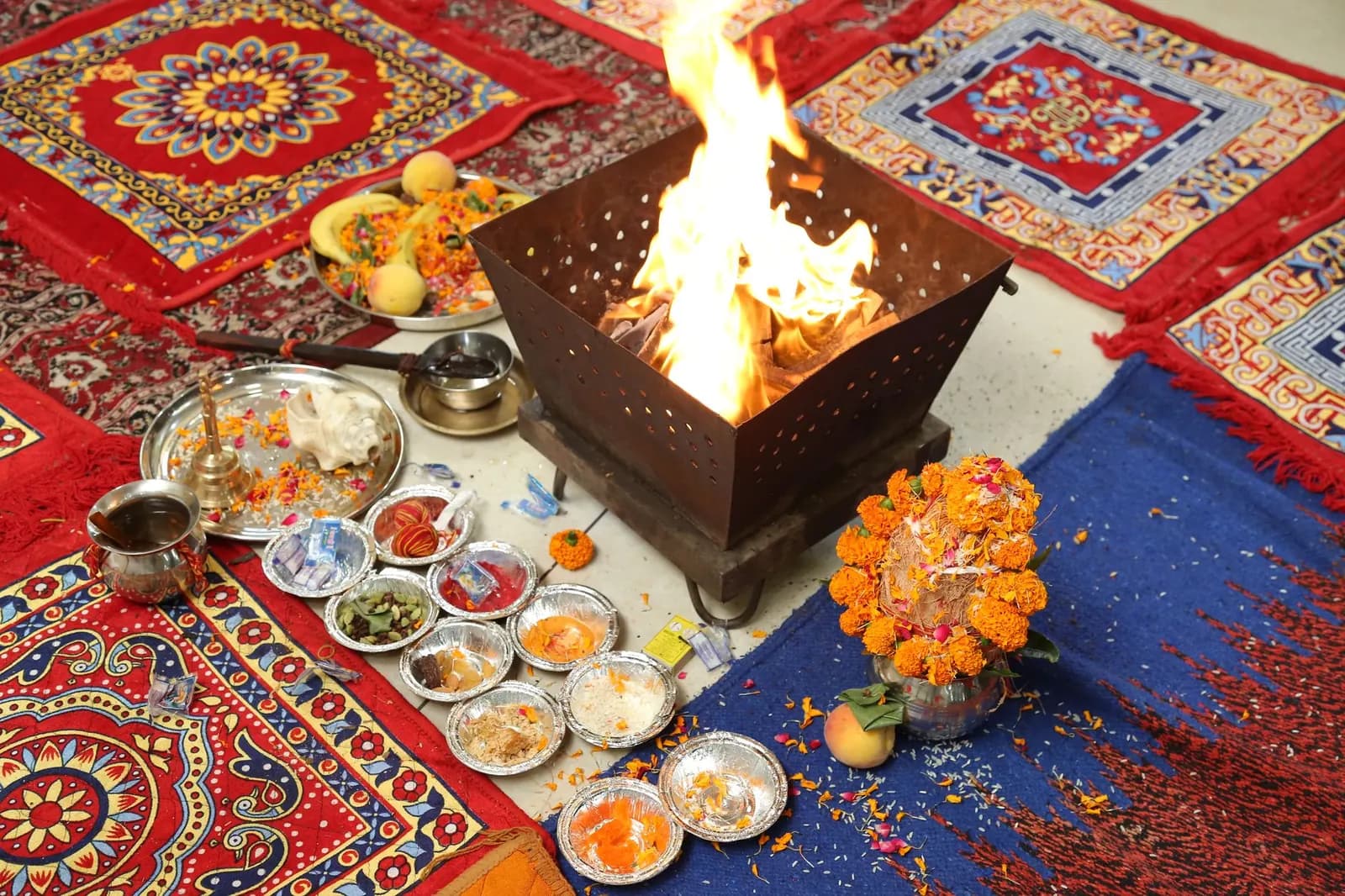
The traditional response is a gand mool shanti, a pacifying puja, not a lifelong observance. Common elements, which vary by region and family:
- Timing. It is usually performed when the Moon returns to the same nakshatra it was in at birth, which happens about 27 days later. Some families do it on that day; others do it later, on a day a priest chooses.
- The puja. Worship of the deity associated with the birth nakshatra, Navagraha (nine planets) worship, and recitation of mantras for the nakshatra and for Mercury or Ketu, depending on which side of the junction it falls.
- Customs around the father. In some communities the father is asked not to see the child's face until the shanti is done, or to see it first in a reflection in oil or water during the ritual. Many families no longer follow this, and it is a custom, not a rule found in every text.
- Charity. Donations of food, grain or cloth, often to people in need, are a common part of it.
If your family does want a shanti, choose a priest you trust, ask what will be done and why, and be wary of anyone who uses fear to push an expensive package. A simple, sincere ritual is as traditional as an elaborate one.
What a gand mool birth does not mean
The worry around gand mool usually comes from sayings passed down in families, often specific and frightening: that the child will bring trouble to a father, mother or sibling, depending on the nakshatra and pada. Here is what is worth knowing.
- It predicts nothing fixed about your child. A birth chart is read as a whole: the lagna, all nine planets, the houses, yogas and the dasha periods. The Moon's nakshatra is one detail out of many, and no serious reading rests on it alone.
- It does not make a child a cause of harm. Some classical and regional texts do list effects by nakshatra and pada, such as a difficulty for a father or a maternal uncle. Tradition itself attaches those lines to one detail of the chart and prescribes a shanti to settle them. Nothing in the calculation looks at anyone's health or fortune, and treating a baby as a source of misfortune does real harm.
- It is not a dosha in the usual sense. It is not like Manglik dosha or Pitra dosh, which are read from house placements and combinations of planets. It is a note about the Moon's position at birth, and once the shanti is done, tradition itself treats the matter as closed.
- The nakshatras themselves are not "bad". Ashwini is linked with the healing twin gods, Magha with ancestors and dignity, Revati with nourishment and safe journeys. Moola means "root". Astrologers traditionally read people born under these stars with the same range of qualities as anyone else.
If the label has made you anxious, it may help to look at the rest of your child's chart, or simply to set it aside. Neither choice is a mistake.
Gand mool and choosing a name
The naming syllables in the table above come from the same nakshatra and pada, which is why a gand mool birth often comes up again at the naamkaran (naming ceremony). A family that follows the custom picks a name starting with the syllable for the child's pada, for example Ye, Yo, Bha or Bhi for Moola. If you are curious how a name maps back to a sign, our guide to rashi by name explains why a name rashi and the Moon rashi can differ. Being a gand mool birth does not restrict the choice of name in any way.
Questions people ask
Is a Moola nakshatra birth always gand mool?
By the usual six-nakshatra list, yes: Moola is one of the six. Most astrologers give the most weight to Moola's first pada, the one right at the start of Sagittarius, and treat the later padas as milder or leave them out.
Is gand mool shanti compulsory?
No. It is a traditional, optional ritual, and many families skip it without any consequence. Whether to do it is a personal and family decision; it is never a substitute for medical care.
Can gand mool be checked by date of birth alone?
Not reliably. The Moon spends about a day in each nakshatra, and the change can happen at any hour, so the date alone can leave two possible nakshatras. You need the birth time, and ideally the place, to be sure.
Does a gand mool birth affect the parents?
Some texts and many family sayings link certain padas to a father, mother or sibling. These are traditional beliefs, not evidence of anything, and nothing in the calculation looks at the parents' lives. A child's birth star does not harm anyone, and nothing in a careful reading supports blaming a baby for a family's difficulties.
Can I ask Astroliya about my child's chart?
Yes. Make the kundli first, then you can ask Astroliya's AI astrologer questions such as which nakshatra and pada the Moon is in and what tradition says about it. It is an AI, so treat its answers as an explanation of the tradition, not a verdict on your child.
From the Astroliya store
Pieces for this guide
Chosen from our own store to go with what you just read.


